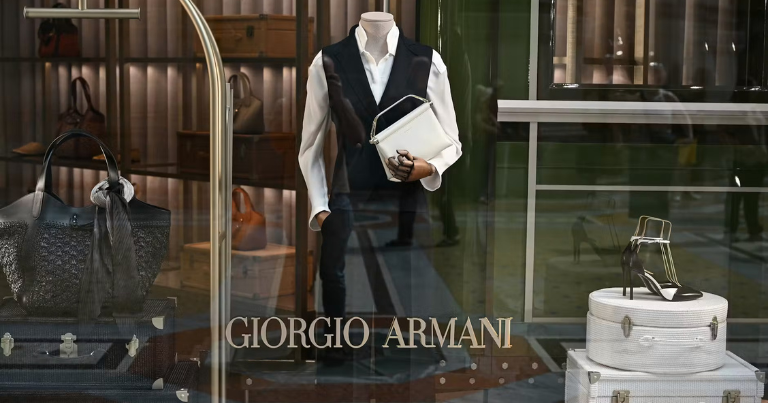
For decades, buying Armani required persuading a man who had little interest in selling. Now prospective investors face a different negotiation: how to buy into a business whose founder has already set the terms of his departure. Giorgio Armani’s succession plan puts a question usually left to the next generation directly into the ownership process: who can be trusted to keep the brand recognisable?
Marketing commentator Mark Ritson describes the plan as potentially Armani’s finest strategic decision. That judgement will take years to test. What makes the arrangement interesting now is its acknowledgement that a company built around one person may need a different ownership structure once that person is gone.
Armani spent much of his career defending his independence. Following the death of his business and personal partner Sergio Galeotti in 1985, he continued to run the company rather than sell it. Retaining control gave him the authority to make commercial decisions according to his own understanding of the brand. For four decades, the person whose name appeared on the products remained available to decide what belonged under that name.
His will anticipates the end of that arrangement.
A timetable for handing over control
The plan calls for an initial 15% stake to be sold between 12 and 18 months after Armani’s death in September 2025. LVMH, L’Oréal and EssilorLuxottica were named as preferred buyers, with scope for other investors of comparable standing. A further sale is envisaged between the third and fifth years, with a stock market listing as an alternative route.
The first stage is now approaching. Reuters reported on 27 September that chief executive Giuseppe Marsocci was open to the possibility of several investors sharing the initial stake. No decision had been made, and any transaction would still depend on agreement over price and terms.
For a potential buyer, the minority investment would therefore sit within a much longer succession process. For Armani’s successors, the timetable provides a framework for decisions that could otherwise become prolonged arguments over what the founder would have wanted.
There is a useful distinction here for anyone managing a brand closely associated with its creator. A founder’s preferences can be remembered, discussed and selectively invoked. An ownership plan gives the business something more concrete to work with. It establishes when change should happen and identifies organisations considered suitable to participate.
It cannot settle every future creative or commercial disagreement. It can, however, reduce the uncertainty surrounding who gets to make those decisions.
The shortlist reveals where the brand’s value sits
The three preferred buyers also offer an unusually clear view of Armani’s business.
LVMH brings experience managing fashion houses whose founders are long gone. Its appeal is straightforward: an organisation accustomed to coordinating design, retail, investment and heritage across a portfolio of luxury brands.
L’Oréal and EssilorLuxottica bring a different kind of familiarity. Both have already helped turn the Armani name into products bought well beyond its fashion boutiques. L’Oréal operates Armani’s beauty business under a licensing agreement running to 2050. The Armani eyewear relationship with Luxottica dates back to 1988.
Their inclusion suggests that experience translating Armani into other categories counts for something in the succession plan. A perfume or pair of glasses must make the name desirable to customers who may never buy a Giorgio Armani suit. That requires commercial reach, but it also depends on maintaining a credible connection to the fashion house.
For marketers, this is the most revealing part of the shortlist. Licensing partners are often discussed as routes to distribution and revenue. Here, two such partners are also prospective custodians of the company behind the name. Years of working with the brand may become a qualification for owning part of it.
Each candidate would nevertheless arrive with different priorities. Managing a luxury fashion portfolio, selling beauty products and operating an eyewear business demand different capabilities. Familiarity with Armani in one category would not, by itself, answer every question about running the wider group.
That is also why the possibility of shared ownership deserves scrutiny. Several investors could contribute complementary expertise. They could also complicate decisions if their interests diverged. The allocation of authority would matter as much as the allocation of shares.
Ritson’s reading is persuasive because Armani addressed a weakness that success can conceal: a highly coherent brand may still depend heavily on one individual’s judgement. Yet a well-considered succession plan remains a plan. Its effectiveness will depend on the agreements reached and the decisions made afterwards.
The next owners will inherit considerable recognition, established partnerships and a founder’s instructions. Their harder task will be deciding which changes Armani can make while remaining convincing to its customers. The will sets that work in motion; the people who follow it will have to earn the authority Armani once supplied himself.