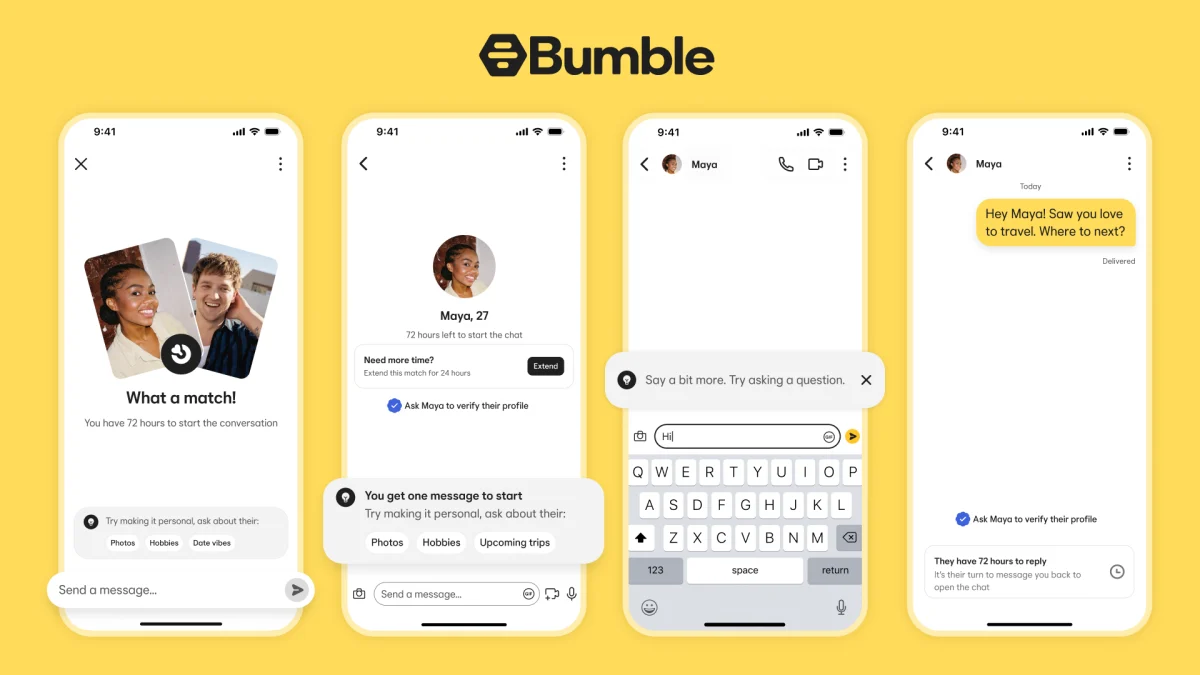
Bumble is scrapping the rule that built its entire brand. Starting today, anyone can send the first message after a match, regardless of gender.
Bumble launched in 2014 on a single idea: women message first. That premise just disappeared. As of August 11, the app is rolling out a global update that lets either person in a match send the opening message. Neither side is locked out anymore.
The mechanics are more considered than a simple switch flip. Once two people match, both get one opening message to send. The chat only fully unlocks once the other person replies. Bumble is also stretching the reply window from 24 hours to 72 hours, and it’s nudging people who type lazy one-word openers like “hey” with a prompt to try something more specific.
CEO Whitney Wolfe Herd, who founded the app, flagged the shift back in May, but the actual rollout goes further than what she described then. Bumble says internal research found that 62 percent of users, women and men, feel more confident when they get a choice in how a conversation starts, and the company is framing that as the justification for finally letting go of its founding mechanic.
Why it matters
Women-message-first was never just a feature. It was the whole pitch, the thing that separated Bumble from Tinder and Hinge and justified its existence as a business. Removing it is Bumble admitting that the founding differentiator has stopped working as a growth lever.
That admission comes from pressure, not curiosity. Tinder remains the top dating app in the US by market share, and Bumble has spent the past couple of years trying to reverse a stretch of user and revenue softness. A structural rule that limits who gets to initiate contact is, mathematically, a rule that limits total messages sent. Loosening it is a straightforward way to increase activity on the app, even if it costs Bumble some of its original identity.
The bigger picture
Bumble’s messaging change is one piece of a wider repositioning. The company introduced an AI matching assistant called Bee back in March, and Wolfe Herd has talked about in-person events and AI as the two pillars of where Bumble goes next. Dropping the gendered rule fits that pattern: it’s Bumble trimming away the parts of its original product that made it distinctive but also made it smaller, in favor of features that look more like what’s already working for competitors.
It also reflects something happening across dating apps generally. Hinge has leaned into prompts and profile depth to fight swipe fatigue. Tinder has experimented with AI-assisted matching. The entire category is moving away from rigid, rule-based interaction models toward more flexible, guided ones, and Bumble’s shift from a strict gender rule to an “everyone gets one shot, make it count” model is very much in that lane.
What’s next
The update is live globally as of today, so the real test starts now: does removing the rule actually increase conversations, or does it just make Bumble function more like Tinder without the brand story that made it stand out in the first place. Bumble will likely point to engagement numbers on its next earnings call as evidence the change worked. Investors and users will be watching the same numbers for different reasons.