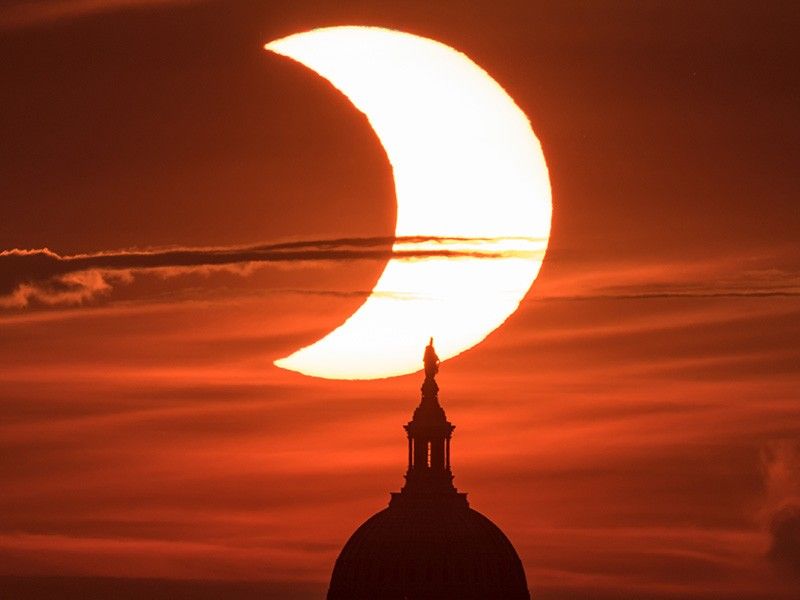
Today, August 12, 2026, the Moon’s shadow is sweeping across the Arctic, Greenland, Iceland, and northern Spain, producing Europe’s first total solar eclipse since 1999. For the roughly two minutes of totality along the narrow path, day turns briefly to twilight.
The eclipse begins at sunrise over Russia’s remote Taymyr Peninsula, then crosses the Arctic, Greenland, Iceland, the Atlantic, and northern Spain before ending near sunset. Maximum eclipse occurs at 17:47 UTC, with totality lasting about two minutes and eighteen seconds at its longest point. The path of totality itself is narrow, passing over the Arctic Ocean, Greenland, Iceland, the Atlantic, Portugal, and northern Spain, which is why forecasters and eclipse chasers have concentrated on Spain and Mallorca as the most reliable viewing spots, given persistent cloud cover risk further north.
Totality is the rare part of the story, but the partial eclipse is the part most people will actually see. The partial eclipse moves through Alaska and northern Canada in the morning, reaches the northern contiguous United States around midday, and arrives in the UK, Ireland, mainland Europe, and Africa in the evening. That means millions of people from London to Berlin to New York will experience Moon taking a bite out of the Sun without ever leaving their city. Safety note worth repeating for readers tempted to look up: It is extremely dangerous to look at eclipse without proper eye protection. Only special glasses intended for watching eclipse must be used.
Why does this matter beyond the spectacle? Total eclipses are genuinely rare for any given location. A total solar eclipse is visible from the same spot on Earth only about once every 400 years, which is why cities along the path, particularly in Iceland and Spain, have leaned into tourism and livestreamed coverage rather than treating it as a niche astronomy event. Scientists are using the moment too. Researchers at the National Solar Observatory use total eclipses to study the Sun’s corona and how it interacts with Earth, data that’s harder to gather without the Moon conveniently blocking the Sun’s overwhelming brightness.