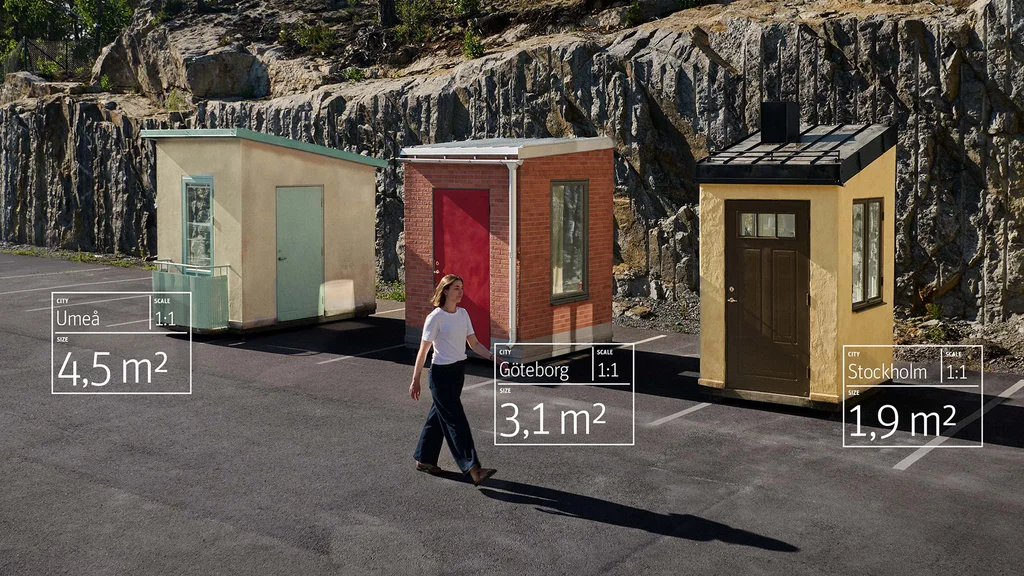
In Stockholm, the average 25-year-old can afford roughly 1.9 square metres of housing today. That’s smaller than most parking spaces. To make that number impossible to shrug off, Swedish housing developer Riksbyggen and creative agency BBDO Nordics built it: a full-scale, livable house sized to exactly what a young buyer can afford, and put it on public display.


What happened
The campaign, called Sweden’s Smallest Homes, consists of three full-scale houses, each sized to what an average 25-year-old could realistically buy in a different city, based on income, local property prices and mortgage conditions. Stockholm’s version is 1.9 square metres, barely enough for four walls, a toilet and a seat, with no room to lie down flat. Gothenburg’s comes in at 3.1 square metres, Umeå’s at 4.5. Each house is styled to match its city’s architectural period, from turn-of-the-century detailing to functionalist and contemporary design, so the contrast between Sweden’s building heritage and its current affordability sits in the same frame. A companion video shows people awkwardly living in the spaces: a microwave next to the toilet, feet propped against the wall, someone listening to music from the doorway because there’s nowhere else to stand. The houses are now touring the country.
Why it matters
Housing affordability statistics rarely move anyone. A number like “1.9 square metres” is easy to read past. A house that size, one a person can physically step inside, is not. Riksbyggen built the campaign around its own Square Metre Index, a formula the company already uses to track affordability, and turned it from a spreadsheet metric into a structure. The campaign also isn’t just brand storytelling. It ends in three specific policy asks: build more housing, introduce cheaper state-backed loans for first-time buyers, and bring back social housing support for older residents so they can downsize and free up family-sized homes for younger buyers.
Bigger picture
The campaign landed with Sweden’s housing minister, Andreas Carlsson, who visited the houses in person, and Riksbyggen CEO Johanna Frelin has been specific about which reforms are gaining traction, telling press that state-backed start loans currently have the strongest political support. That’s a housing developer functioning as a lobbyist with a media budget, and it fits a wider pattern across Europe, where young adults are increasingly locked out of ownership and companies with a stake in the outcome are using advertising to apply public pressure rather than waiting on policy to catch up on its own.
What’s next
The houses will keep touring Swedish cities through the rest of the year, and Riksbyggen appears to be betting that sustained visibility, not a single news cycle, is what shifts a housing debate. Whether any of the three proposed reforms actually reach legislation is still an open question, and one worth watching as other European markets face the same affordability squeeze among their own younger buyers.