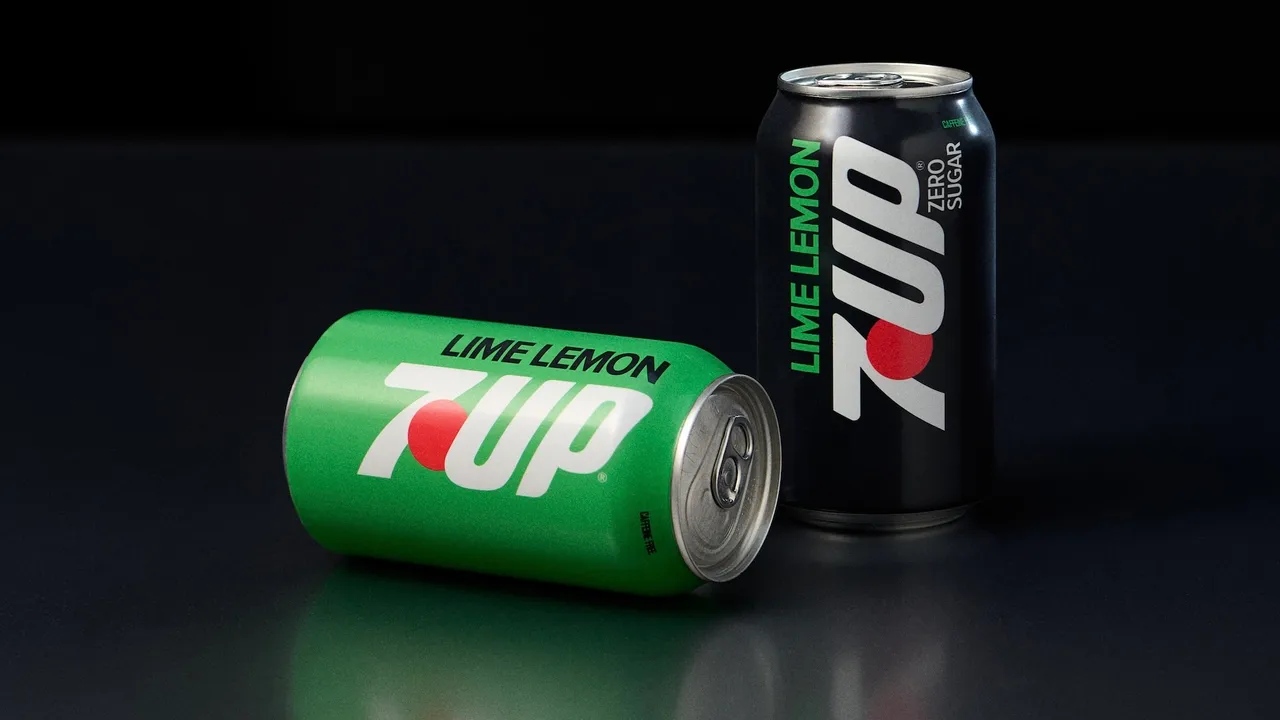
7up is dialing back its lemon flavoring and pushing lime further forward, the brand’s first recipe change in 15 years. The reformulation took two years to develop internally and lands first in Cherry 7up and the zero-sugar line, both due out in mid-August, ahead of a fuller rollout across the core lineup in the coming weeks. The packaging is changing too: the familiar “lemon lime” text flips to “lime lemon,” and the can gets a new vertical logo, though the red dot and the red-white-green palette that have marked the brand since the 1960s stay put.
Drew Panayiotou, chief marketing officer for Keurig Dr Pepper’s U.S. refreshment beverages, was careful to frame this as evolution rather than admission of failure. “Bringing lime more to the forefront is an improvement, but not that anything was broken,” he said. The company’s own research is doing the heavy lifting here: 72% of Gen Z and Gen Alpha soda drinkers say they prefer citrus-forward flavors like lime over the softer, more traditional lemon profile 7up has leaned on for most of its history.
Why lime, and why now
The lemon-lime category is worth roughly $5 billion a year in the US, and 7up has spent decades losing that fight. Sprite holds about 9% of the market as of 2025; 7up sits at a distant 1.2%. Starry, Poppi, Olipop, and Zevia have all carved out real space in the same aisle by selling either a cleaner ingredient story, a gut-health angle, or both, and Gen Z shoppers have shown they’ll switch brands for it.
Sprite hasn’t done anything differently to widen that gap. A whole generation of smaller brands has proved that “familiar” no longer counts as a strong enough pitch on its own, and the fastest way for a legacy brand to feel current, short of launching something entirely new, is to change the thing people already know. Panayiotou put the underlying calculation plainly: “The biggest risk you have with brands is stagnation and not wanting to evolve.”
The bigger problem behind the recipe tweak
This is happening inside a broader repositioning at Keurig Dr Pepper, not in isolation. The company has been rolling out more than 35 new drinks across its portfolio this year, and it says zero-sugar sodas are now generating six times the dollar growth of regular versions, which is why every 2026 carbonated soft drink launch, 7up included, is coming out in both forms simultaneously. Internally, the company points to Gen Z’s shopping behavior as the reason for the pace: 72% of that group say they actively try a new beverage at least once a month, which is a very different consumer than the one legacy soda brands were built to hold onto with a fixed recipe and decades of shelf familiarity.
It also fits a pattern that’s become hard to miss across CPG generally. When a heritage brand’s growth stalls, the fix increasingly runs straight through the core product rather than a companion launch sitting beside it on the shelf. That’s a bet that existing buyers’ attachment to the old formula is smaller than the upside of winning over buyers who never had that attachment to begin with. Dr Pepper Creamy Coconut, one of the company’s most successful limited releases to date, reportedly grew out of watching social media trends rather than traditional flavor R&D, which tells you where the innovation pipeline is actually looking these days.
What comes next
Beyond the recipe change, Keurig Dr Pepper has more 7up variants queued up: a 7up Shirley Temple limited release for the holiday season, and a Kroger-exclusive 7up Endless Summer Mandarin Orange aimed squarely at the same citrus-leaning, flavor-curious younger buyer the lime shift is designed for.
None of this guarantees 7up closes the gap with Sprite, and a percentage point of market share built over decades doesn’t move because of one can redesign. But the bet itself is instructive. For a 97-year-old brand, changing the flavor is the low-risk version of admitting the old formula wasn’t pulling in the customers who’ll decide the category’s next decade.