
Agency strategists are feeling better about their jobs than they did a year ago, according to WARC’s Future of Strategy 2026 report, released on 5 October. The same survey shows they are also far more worried that AI will replace them.
The study polled 489 strategists worldwide in August 2026, most of them agency-side. Two-thirds (66%) said there are clear reasons to be optimistic about the discipline.
Clients are listening again
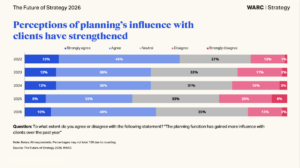
The headline number is influence. Half of respondents (50%) said the planning function gained more sway with clients over the past year, up from 41% in 2025.
That recovery comes after several hard years of agency consolidation, smaller teams and senior talent leaving the industry. WARC’s reading is that clients still need strategic thinking, even as agencies have cut the people who provide it.
The longer view is less rosy. In 2022, 59% of strategists said their client influence was growing. This year’s figure is a rebound, not a return to where things were. Influence inside agencies hasn’t moved either, sitting flat at 46%.
“Last year’s report painted a gloomy picture of agency-side strategy,” said Lena Roland, Content Director at WARC Strategy. “Twelve months on, the mood has shifted.”
The AI anxiety is growing faster than the optimism
The more striking shift is fear. 56% of strategists now worry AI will replace their roles, up 15 percentage points from 41% last year. It is now the threat they expect most.
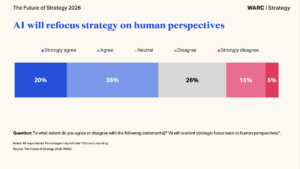
At the same time, many say AI is changing their work for the better. 65% are spending the time it frees up on more nuanced strategic work, and 55% think AI will push strategy back toward human perspectives.
The catch is in the research habits. Only 23% of strategists run in-person qualitative research at least once a month, down from 35% in 2025. If understanding people is the thing machines can’t do, fewer strategists are actually going out to meet them.
Elizabeth Paul, Chief Brand Officer at The Martin Agency, put it bluntly: “AI should not give strategists permission to do less human research. It should give us the time to pursue more extraordinary truths with greater depth.”
Proving value is still the hard part
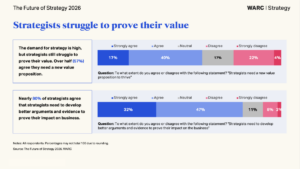
Demand for strategy is up, but strategists are struggling to show what it’s worth. 57% agree they need a new value proposition, and 79% say the profession has to build better arguments and evidence for its business impact.
Much of strategy’s value is indirect. It shows up as better decisions and less wasted spend, which rarely appears neatly on a client’s P&L. That makes the job harder to defend when budgets get cut.
Stacy Taffet, Chief Growth & Marketing Officer at The Hershey Company, made the case from the client side: “The ROI on strategy is very high because when you do the upfront work to clarify brand foundations and business problems, ongoing content creation becomes effortless and more cost effective.”
Why it matters
Strategists want a bigger role. 83% expect their job to involve shaping business strategy, not just communications, over the next five years. The same share expects to work more closely with data science and AI teams.
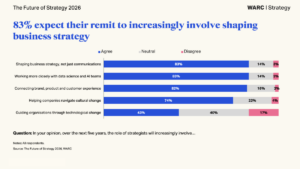
One new pressure pushing them there is what WARC calls the “two audience problem”: brands now need to win over both people and the AI systems that increasingly search, recommend and buy on their behalf. That pulls strategy into customer experience, PR and agentic commerce, areas well outside the traditional creative brief.
There’s a gap in the data, though. While 82% expect to connect brand, product and customer experience, only 43% think they’ll be guiding organisations through technological change. Strategists see AI reshaping their clients’ businesses, yet most don’t see themselves leading that shift.
Nikita Walia, partner at U.N.N.A.M.E.D., argues the strategists who last will be the ones who understand “how things get made, distributed, and measured,” not just messaging and positioning.
What’s next
The full report is available to WARC subscribers. WARC has made a selection of 16 expert opinion pieces free to read, and a podcast on the findings launches on 8 October.
For agencies, the takeaway is practical. Clients are giving strategists more room, but that window will only stay open if strategists can tie their work to revenue, retention and cost in language a board understands.
Sources: WARC press release, “Cautious optimism returns to agency-side strategy as influence with clients grows” (5 October 2026); WARC Strategy; free opinion pieces
Image credits: All charts from The Future of Strategy 2026, WARC, supplied in the official press release.








