A campaign can survive every presentation, accommodate every comment and reach its audience with very little left to say. Each revision seems reasonable. Together, they can remove the very thing that might have made someone pay attention.
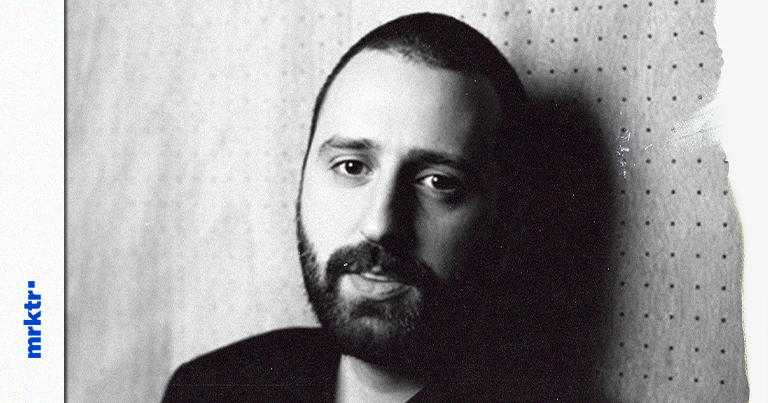
For Sandro Tsitskishvili, Co-founder and Creative Director of Supermarket, this is where much of advertising’s risk now sits. A brand’s carefully approved film enters the same feed as breaking news, political arguments, memes and someone’s pet. Making it easier to approve does not necessarily make it more likely to work.
That tension runs through our conversation: how ideas lose their force, why a long relationship with an agency can change a client’s appetite for risk, and what creative teams owe the businesses that trust them. Sandro is candid about the times his own conviction has been misplaced. He is equally direct about the cost of spending money on work that leaves no impression.
M: When a client says an idea is too risky, what are they usually afraid of: the audience’s reaction, the business outcome or their own management’s judgement?
Interestingly, I hear that sentence less often now. That does not mean the concern has disappeared. Different clients are afraid of different things.
Some still work by older rules and struggle to keep up with how communication has changed. They may describe an idea as risky simply because it is bold. Others are worried about how they will explain it to their management.
Sometimes the fear is personal; sometimes it belongs to the organisation. Personal fears are usually easier to work through in a conversation. Corporate fears are more complicated. A brand can become a victim of its own bureaucracy, internal rules or way of thinking. It ends up operating only within familiar boundaries, even when that approach is working badly for it.
M: Have you presented an idea that immediately met with discomfort or resistance? What convinced you it was worth defending?
Many times. Sometimes, even as I am explaining an idea, I can already tell that its chances are slim.
Looking back at my younger self, I can also admit that my reasons for defending an idea were not always entirely professional. Some ideas made sense for the task. Others came from somewhere more personal: I wanted them to happen. I was not always as concerned as I should have been with what they would actually achieve. That has changed.
But when an idea is judged too risky, I also have to consider my part in that reaction. Perhaps I have presented it badly. Perhaps the timing is wrong, or the people who need to hear it are not in the room.
The same idea can have a very different future depending on when and how you explain it. Its reception is not determined by the idea alone.
M: How do you distinguish an unfamiliar idea that people may need time to understand from one that simply does not work? When do you question your own creative instinct?
We try to filter those ideas out early, as a team. If an idea is difficult for its intended audience to understand, or requires them to catch up with it later, I would question whether it works in the first place. If it cannot catch someone’s attention immediately, whatever follows may never get seen.
That brings us to what we actually mean by a risky idea. Ten years ago, we often meant something bold in its content, visual treatment or format. Getting that particular approach approved was the risk.
Today, I think a supposedly safe idea can be much riskier.
An advertisement used to compete with another advertisement. Now your video is competing with a meme, a news headline, a politician’s statement, a war, a TikTok, an influencer’s argument with another influencer, or a flood in the city. That is the environment you are putting your work into.
If the idea is not sharp, specific and responsive to that environment, it has very little chance. A moderate statement disappears almost immediately. An enormous amount of other content lands on top of it, much of which has nothing to do with advertising.
Relevance has always mattered. I am not suggesting we have only just discovered it. But I now think in terms of “super-relevance”: understanding what matters on that particular day, or finding an angle that gives people a reason to notice.
Some brands still approach communication through an older model. What they regard as a cautious decision can produce the most forgettable work. That is where both clients and agency people can misjudge the risk.
M: Clients want evidence that an idea will work, but an original approach may have no direct precedent. What do you build your argument on, and what can you reasonably promise?
The starting point is the insight and the relevance of the territory we are proposing. Before discussing a particular execution, we need to understand whether this is something the brand should be talking about, whether it matters to the audience, and which human behaviour we are trying to address.
I want those early decisions to be strong enough that the entire argument does not depend on one particular script. The writing, direction and creative execution then help us make that thinking as relevant as possible to the people we want to reach.
But the relationship between the client and the agency makes an enormous difference.
In a one-off project, you start from the beginning. The agency has to get to know the brand, understand its business and build trust. The client may need reassurance at every stage. It becomes a longer, more complicated process.
With a continuous relationship, much of that groundwork already exists. At Supermarket, we try to build long-term strategic partnerships. In those relationships, the conversation is much more directly about business challenges and how to solve them.
The agency’s promise changes, too. It cannot simply be: “Look at this beautiful idea. I feel sure it will work.” You are discussing objectives, KPIs and the criteria by which the work will be judged. Those might concern business growth, brand perception or establishing the brand in a particular territory. Either way, there is a task to fulfil.
That takes the discussion beyond personal taste. Earlier in my career, it could feel as though I brought an idea I liked, the client happened to like it too, and we made it to see what would happen. The conversation is much more rational now, and I enjoy that.
A one-off campaign also puts the client under enormous pressure. They have one shot, so it has to be exceptional. I understand why that makes them cautious. I would probably feel the same.
Yet you can launch a campaign in the morning and, by the afternoon, something has happened that consumes everyone’s attention. A photograph taken on someone’s phone can overwhelm work that cost a great deal to produce.
When there is an ongoing relationship, you can assess decisions within a wider period of activity. Some things will work better than others. What matters to me is how successful the brand becomes over time. An excellent campaign can still be overtaken by events on the day it launches.
M: A bold campaign might bring an agency professional recognition while exposing the client to financial or reputational risk. How do you reconcile those interests?
A good agency wants to do every piece of work well. That ambition should be present in everything it makes.
But a business does not commission advertising so that you can put it in your portfolio. It comes to you and spends money because it wants its business to grow.
We also need to ask what we mean by recognition. Is it someone telling you they loved your advertisement? Or is it a campaign that delivers such strong results over the following year that it wins an Effie? That campaign might never have been the most talked-about piece of work. It may have used a particular mechanism that produced a meaningful benefit for the business.
We judge success by what the work does for the client: whether the business grows, whether people feel more strongly about the brand, whether we fulfil the objective.
Of course, personal recognition matters. A great deal of effort goes into this work, often from many people, and it feels good when that effort is acknowledged. But an agency’s success ultimately depends on its client’s success.
M: An idea can get approved and still lose everything that made it distinctive during revisions. How do you recognise when a compromise has gone too far?
That is one of the most important parts of the process. An idea begins with a certain sharpness. Then it goes through rounds of testing, checking and adjustment.
I understand why those processes exist. But I am sceptical of endless testing because it can blunt the idea. You keep checking whether it is right, correcting it, making it more acceptable, until you arrive at an average version. You could ask AI for something like that. Then you release it and nothing happens.
That is a financial risk as well as a creative one.
People have good ideas. What happens to those ideas afterwards is crucial. An idea might begin with one, two or three people, and then many more become involved. Those people can make valuable contributions, whether they are on the client’s side or the agency’s. But each stage also creates an opportunity for the idea to lose its meaning.
I have seen work that was excellent on paper deteriorate because of decisions made later. Clients do this, but agencies do it too. Someone inside an agency can become overly cautious on the client’s behalf and damage their own idea.
The process can look responsible from the outside. Everyone appears to be making the work safer. Meanwhile, they may be removing its ability to do anything.
Protecting that ability is a central part of creative direction. Once an idea exists, there can be months of work ahead. Every day of those months brings decisions that can change it.
M: When a campaign attracts a backlash, how do you decide whether to defend it, change it or stop it? What does the agency owe the client at that point?
I have experienced that. We believed strongly in an idea, convinced the client it was the right decision, launched it and faced a serious backlash.
There have also been cases where the client warned us about something and we believed in the idea so much that we underestimated the possibility of it happening. Then it happened. Agencies make mistakes. Large brands make mistakes.
What happens next depends partly on how the reaction develops. A backlash has its own momentum. Sometimes you decide to pause, remove the work or issue a statement. Sometimes you watch how the discussion evolves. It can happen at any hour; you may find yourself making that decision at five in the morning.
The relationship matters here as well. If everything rests on a single campaign, the pressure is enormous.
The agency has substantial responsibility. The client ultimately approved the work, but that does not give you a reason to hide behind the approval. You do not turn up afterwards and use a previous agreement to distance yourself from what happened.
You acknowledge your mistake and work with the client to put it right.
M: Does every brand need to take creative risks? When would a more familiar approach make sense?
Brands have different boundaries, different tones and different strategies. They should take risks within that understanding of who they are. A risky idea does not have to mean doing something outrageous. Producing something simply because everyone will look at it has never been a sufficient reason.
But I would not advise a brand to fill its calendar with activity just for the sake of having activity.
Every brief has an objective. The work needs to reach the right people and do something. If the idea does not move anyone, I struggle to see how it will achieve that.
I often think that if the prospect of launching a campaign does not make either the agency or the client feel anything, why would we expect the audience to feel something?
This is particularly relevant in Georgia. Public life is intense, and people are accustomed to encountering strong stories and unexpected developments. A message can be accurate and based on a genuine insight yet still fail to interest anyone at that moment.
Sometimes our job is to tell a client that the subject they have discussed for ten years no longer holds the same interest. We have to look closely at what people care about now and find a relevant way for the brand to participate.
That requires attention to context and a willingness to respond. Otherwise, you can make something very well and still waste the money.
M: The same idea can sound convincing from an established agency and too risky from an unknown team. How much does the author’s reputation influence what gets approved?
Of course it has an influence. Different people explain the same idea differently. They bring different arguments, confidence and experience.
An idea also needs to be managed. Coming up with it is only part of the work. You have to present it, develop it, take it through production, launch it and keep working with it afterwards. Agencies differ in how well they handle that entire process.
That does not mean you need a famous name to make exceptional work. I have seen young people and agencies nobody had heard of produce extraordinary ideas. There is no rule that says recognition must come first.
But twenty years spent doing this work and learning from it is experience. Someone who has just started cannot be expected to have it yet, and clients will naturally take that into account.
Again, the relationship can change the situation. A small agency that builds an ongoing partnership with a client has the opportunity to develop trust through its work. That is a different position from competing for a single project against an agency whose name and previous campaigns the client already knows.
M: How do you assess a campaign that one part of the audience loves and another dislikes? Whose reaction should carry the most weight?
The brief should tell us who the work is for. Some briefs genuinely ask for broad appeal, and that is a particular task. Others are aimed at a much more specific group.
If you can see that the intended audience has understood and responded to the work, the fact that someone outside that audience did not particularly enjoy it is not necessarily a problem.
You also have to interpret comments carefully. Not everything beneath a campaign tells you something useful about its effectiveness. People greet relatives in comment sections or leave remarks that have almost nothing to do with the work. Negative comments need the same scrutiny.
There is a qualification, though. Someone may be outside the audience for this particular campaign and still matter to the brand. You may be speaking to them elsewhere in your calendar. You cannot simply dismiss everyone beyond the immediate target.
But the people who should be most enthusiastic, who share the work and tell their friends about it, are the people you made it for. A back-to-school campaign does not need to produce exactly the same response in grandparents.
M: Which international campaign best captures the kind of creative courage you are talking about?
Burger King’s “Moldy Whopper” came to mind as soon as we agreed on this subject.
Imagine explaining that idea to a client. You are asking to show its most recognisable product in the worst possible condition. That would be a difficult conversation almost anywhere in the world.
Yet the deterioration was central to the message about removing artificial preservatives. Showing the burger becoming mouldy gave the brand a striking way to communicate that decision.
I used to show the campaign to my students. Some found it disgusting and said they would never eat a Whopper again. Others thought it was brilliant. They were discussing it as a piece of communication in a classroom, so that is not the same as measuring its effect on consumers. But it shows the discomfort an idea like that can create.
I suspect the vast majority of clients would have rejected it. This client approved it, and I think the work will remain a classic.
More broadly, when I think about communication we remember, I often think about the people who had to accept some discomfort to make it happen. They understood why the idea made sense for the brand and its context.
That is what we have to pay attention to now. You can spend a year producing perfectly acceptable communication with no real peaks, and people can gradually forget you.
Meanwhile, a photograph that cost almost nothing can command more attention than a multimillion-dollar campaign. I sometimes imagine a famous TikTok parrot learning a new word on 26 May and overshadowing all the campaigns made for Georgian Independence Day.
It sounds absurd, but that is the competition. We have to watch what is happening around us more closely than ever. When we look for a relevant approach to a brief, that is the world we need to look at.