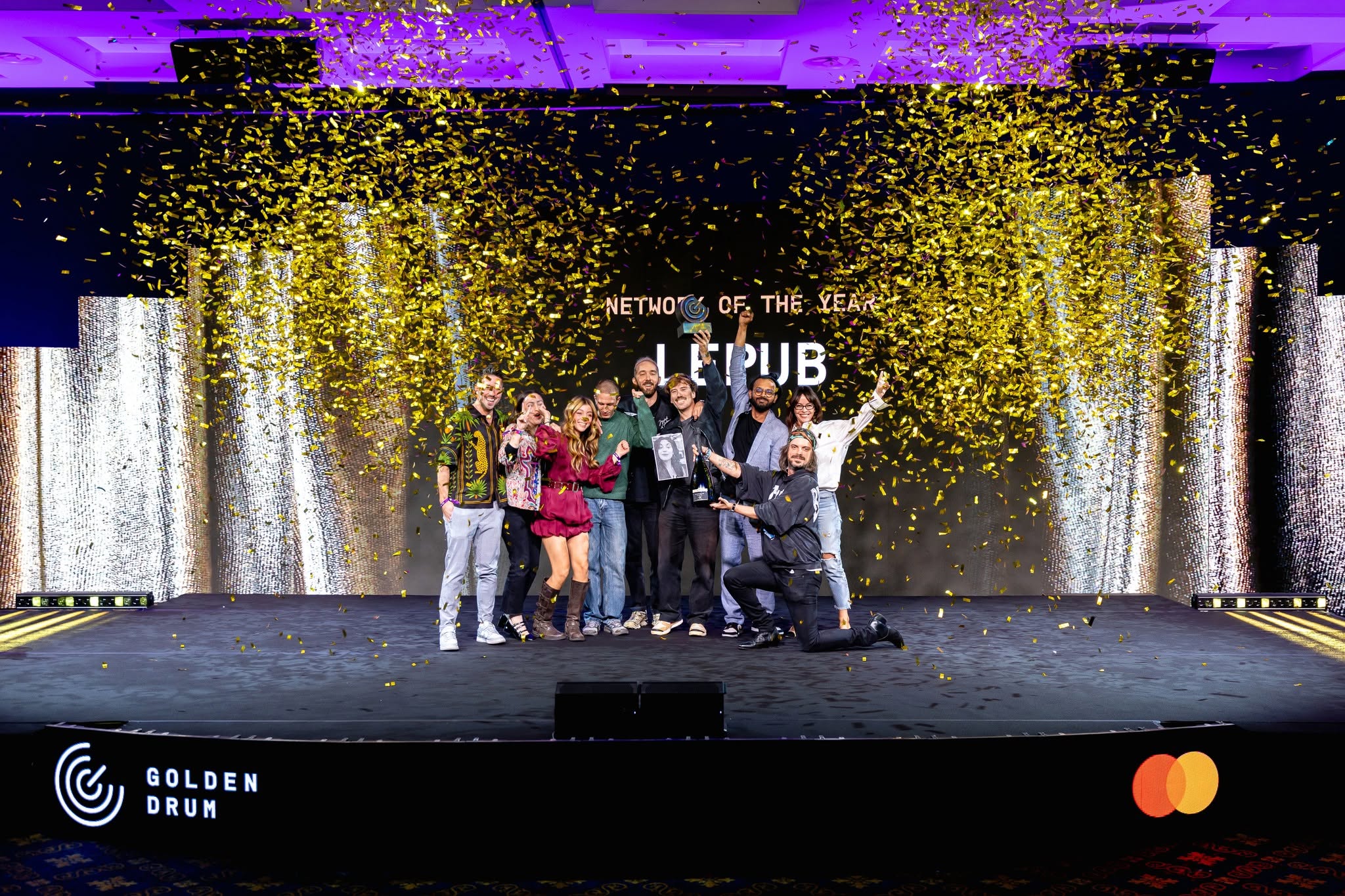
The Golden Drum International Festival of Creativity wrapped up in Portorož, Slovenia, on 13 October with its Awards Show, powered by Mastercard, celebrating work from 30 countries.
From 187 shortlisted entries, the juries handed out 14 Grand Prix, 34 Golden Drums, 46 Silver Drums and 43 Bronze Drums. And one name kept coming up.
LePub’s big night
LePub took both Network of the Year and Agency of the Year for its Milan office. Its creative directors Silvia Oton, Valentino Borghesi, Peter Dobbyn and Geo Joseph were named Creative Director of the Year for “The Pub That Refused to Die”, while LePub Milan also won the Game Changer Award, powered by Telemach Slovenia, for “Tocayos” for Heineken.
Heineken itself was named Brand Grand Prix, and Mihnea Gheorghiu, Global Chief Creative Officer at LePub Network, was inducted into the Golden Drum Hall of Fame.
The rest of the winners
- Independent Agency of the Year (supported by NLB): hasan & partners, Helsinki
- UNFPA Inclusion Excellence Award: hasan & partners, Helsinki, for its work for Naisten Linja
- Media Agency of the Year: CARAT Italia
- Production Agency of the Year: Punk Film, Czech Republic
- Adriatic Agency of the Year (powered by Zavarovalnica Triglav): McCann Skopje
- Best of Social Good: Saatchi & Saatchi Ukraine for “The Healing Stage”, and McCann Poland, Warsaw, for “Here to Stay” for Mastercard
In the Young Drummers Competition, run with Mastercard Slovenia, Ilona Zdravkova and Neli Kirova of HUMAN, Sofia, won with their poster series “Travel Like a Tourist. Pay Like a Local.”
Beyond efficiency
Behind the awards, this year’s programme was built around one question. We spoke to Mojca Briščik, President of Golden Drum, about what made the 2026 edition stand out.
“The programme goes beyond asking how AI is changing our industry and explores a much bigger question: how can we use technological progress to become more creative, rather than simply more efficient?” she says.
That idea ran through the speaker line-up. Fitz Maro from Amazon Ads looked at how AI can take repetitive tasks off our hands and free up time for work that truly needs human creativity. David Guerrero made the case for combining global perspectives with local insight to create ideas that travel internationally. Xavier Blais challenged the industry to spend less time talking about ideas and more time making them happen. Other sessions covered the role of craft in building iconic brands, creativity in shaping products themselves, and how brands can stay meaningful in a world increasingly shaped by AI.
“What connects these perspectives is a strong belief that technology alone will not define the future of our industry,” Briščik says. “Original thinking, cultural understanding, exceptional execution and the courage to take creative risks will matter more than ever.”
A meeting point for the region and beyond
This year’s winners list — from Helsinki to Skopje, Ukraine to Sofia — makes Briščik’s next point for her. She sees the region’s cultural diversity as one of its biggest creative assets.
“Our region has an enormous cultural heritage, a rich history and a remarkable diversity of languages, traditions and perspectives,” she says. “All of this shapes the way we see the world, tell stories and approach creative challenges.”
“Creativity does not belong exclusively to the biggest markets or the largest budgets. Sometimes, a distinct cultural perspective, a deep understanding of local audiences or the courage to approach a problem differently is precisely what makes an idea stand out internationally.”
Beyond the work itself, the festival is about people: exchanging ideas, challenging each other and building relationships across borders and disciplines, with established leaders and emerging talent in the same room.
“Our ambition is not only to celebrate the creativity that comes from this region, but also to help it become more visible, connected and influential internationally — while bringing fresh perspectives and inspiration back into our own creative communities,” she says.
Where the industry is heading
Briščik expects technology to keep speeding up the creative process, but believes that will make human imagination, insight and judgement more valuable, not less.
“AI will undoubtedly change how we work, from automating repetitive tasks to transforming how brands create content, reach audiences and remain discoverable,” she says. “But technology alone cannot define what is meaningful, culturally relevant or emotionally resonant.”
The brands and agencies that win, in her view, will combine technological fluency with strategic clarity, emotional intelligence and exceptional craftsmanship — and bring creativity beyond traditional advertising into products, experiences and the wider ways businesses create value.
“In a world where producing ideas is becoming easier, having an idea that genuinely matters will be what sets the best work apart,” she says. “The future belongs to those who remain curious, challenge conventions and have the courage to turn original thinking into progress.”