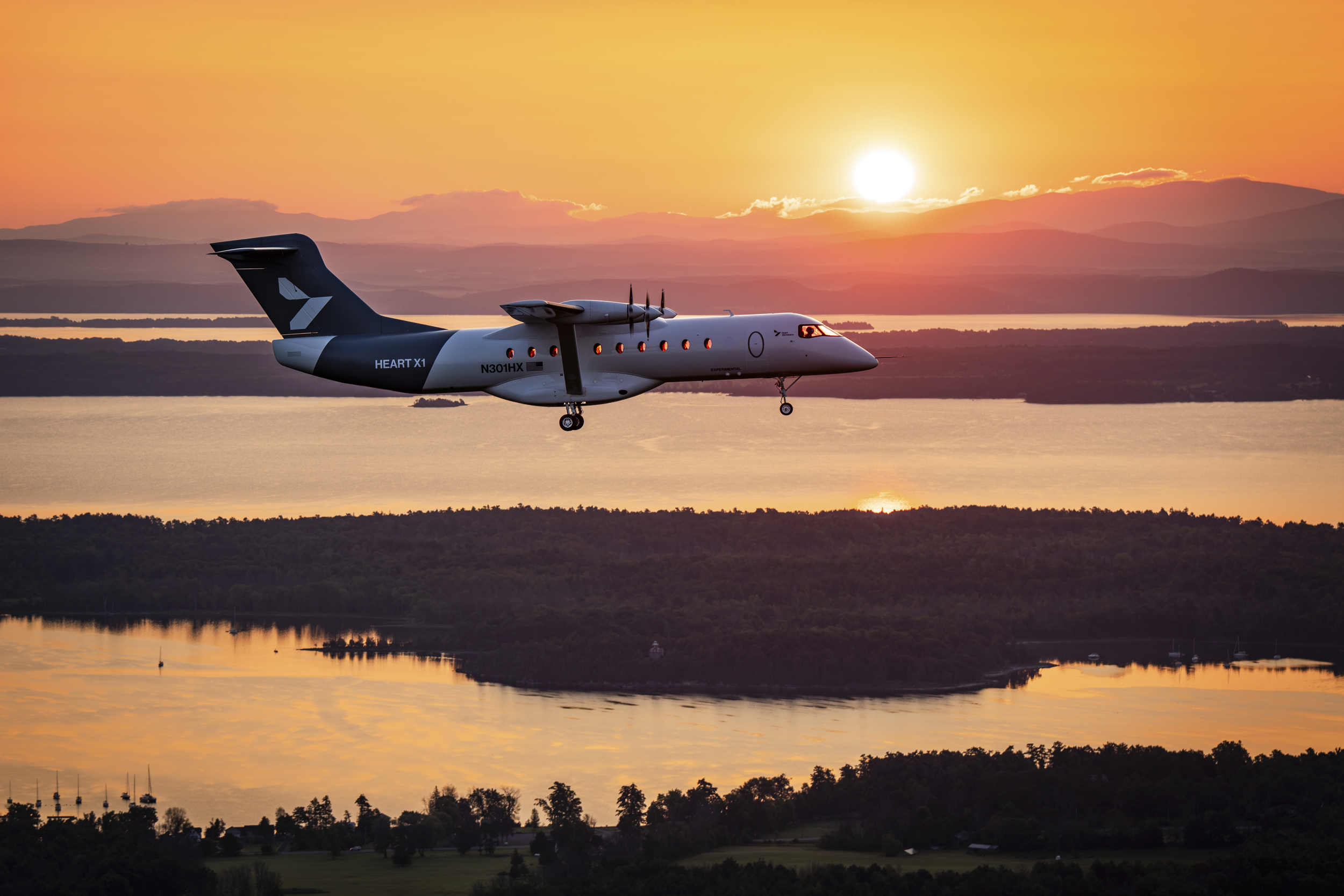
On August 12, a 25,000-pound aircraft with a 106-foot wingspan lifted off from Plattsburgh International Airport in upstate New York, climbed to 1,100 feet, manoeuvred for 27 minutes and landed. The electricity it consumed cost less than $5.
Heart Aerospace’s X1 demonstrator is now, by the company’s own phrasing, the largest battery-electric aircraft ever flown. The previous holder was Eviation’s Alice, an 18,400-pound nine-seater that flew for eight minutes in September 2022 and never flew again. That program is now on hold. The X1 is closer in size to a De Havilland Dash 8-Q300 regional turboprop, the sort of aircraft airlines actually use to move paying passengers between secondary airports.
The X1 is a technology demonstrator flying under an FAA Special Airworthiness Certificate in the Experimental category, with a powertrain delivering more than a megawatt. It is not a product and it will never carry passengers. Its job is to validate systems bound for the ES-30, a 30-seat hybrid-electric airliner Heart wants in service by 2031, with pre-production flight testing starting in 2028.
The ES-30’s published targets explain the hybrid part: about 125 miles on batteries alone, extending to roughly 500 miles with the onboard generators running, and a 30-minute charge. That is a narrow envelope by commercial standards, but it covers a surprising share of regional routes in Scandinavia, Canada and the US interior.
Fuel is one of the largest controllable costs in regional aviation, and electricity is both cheaper per unit of energy and far less volatile than jet fuel. Heart claims direct operating costs more than 40 percent below legacy regional aircraft, and that arithmetic is what brought United Airlines, Air Canada and JSX to the table with what Heart values at $9.4 billion in customer commitments. Worth noting that commitments are options and letters of intent, not cash.
The bigger picture
Heart’s own history is the useful context. The company began in Gothenburg, cut around 70 jobs in February 2024 after a major ES-30 redesign, then announced in May 2025 that it was closing its Swedish operations and moving to Los Angeles, shedding roughly 75 more roles and citing US customers, partners and capital. It has raised about $145 million from investors including Breakthrough Energy Ventures, EQT Ventures, Lowercarbon Capital, United and Air Canada, plus a $4.1 million FAA grant. Against a stated $9.4 billion order book and a 2031 certification target, that is a thin balance sheet.
Meanwhile the alternative-propulsion field has fragmented. ZeroAvia is betting on hydrogen fuel cells, Rolls-Royce on hybrid systems for larger airframes, and several eVTOL companies have quietly discovered how expensive certification is.
What happens next
Watch two things. The first is Heart’s flight-test cadence through 2027, because demonstrators that fly once and then sit in a hangar are a familiar pattern here. The second is cell chemistry. Electric regional aviation does not need a breakthrough so much as steady, boring improvement in energy density arriving on schedule.
The X1 proved a large aircraft can fly on batteries. Whether it can do so profitably, at altitude, with 30 people aboard and a legal fuel reserve, is a different question.