At Ad Black Sea’s tenth anniversary, Kavtaradze connected Georgia’s struggle for freedom, the rise of AI and the pressures of the creative brief in a speech about finding purpose when familiar certainties fall away.
A deadline is approaching. A budget is tightening. An idea is waiting for approval. Beyond the brief, the world keeps moving through political upheaval, war and technological change.
In his speech at Ad Black Sea, Vato Kavtaradze brought these pressures into the same conversation. Exploring the festival’s “On the Edge” theme, he traced a path from Georgia’s geography and history to the working lives of the people gathered before him.
The theme emerged from preparations for the festival’s tenth anniversary. Reflecting on how quickly the years had passed, Kavtaradze described a growing sense that uncertainty touched everything: work, personal life and the wider world.
“We felt that it was more than a metaphor,” he said.
Across the speech, the edge took different forms: a border, a threat, a creative constraint and, eventually, a place of possibility.
Where geography becomes experience
Kavtaradze began with Georgia, situated between Europe and Asia and shaped by its relationship with both. He described a country whose location has long placed it at the meeting point of cultures and competing powers.
From there, he moved into history, reflecting on struggles for independence and the destruction of creative life under Soviet rule. Writers, poets, actors and other cultural figures featured in his account of how authoritarian power targets those capable of thinking differently.
For an audience working in communications, the connection was pointed. The ability to question, imagine and express an independent view depends on freedoms that can come under direct attack.
Kavtaradze linked that history to his concerns about Georgia’s present. He spoke about protests, prisoners of conscience and the country’s European aspirations, paying tribute to people he described as defending shared values.
His attention then turned to Ukraine. He honoured Georgian soldiers killed there and Ukrainian creative professionals who had left their everyday work to defend their country.
These passages gave the festival’s theme a gravity that extended far beyond professional risk. The creative community in his speech included colleagues whose lives had been transformed by conflict, and whose absence could be felt even at a gathering intended to celebrate the industry.
AI and the changing boundaries of creativity
Kavtaradze brought the discussion back to the industry through artificial intelligence.
He described AI as a force capable of changing what people know, experience and create. His concern extended to the power of those controlling the technology, particularly when technological influence and political manipulation intersect.
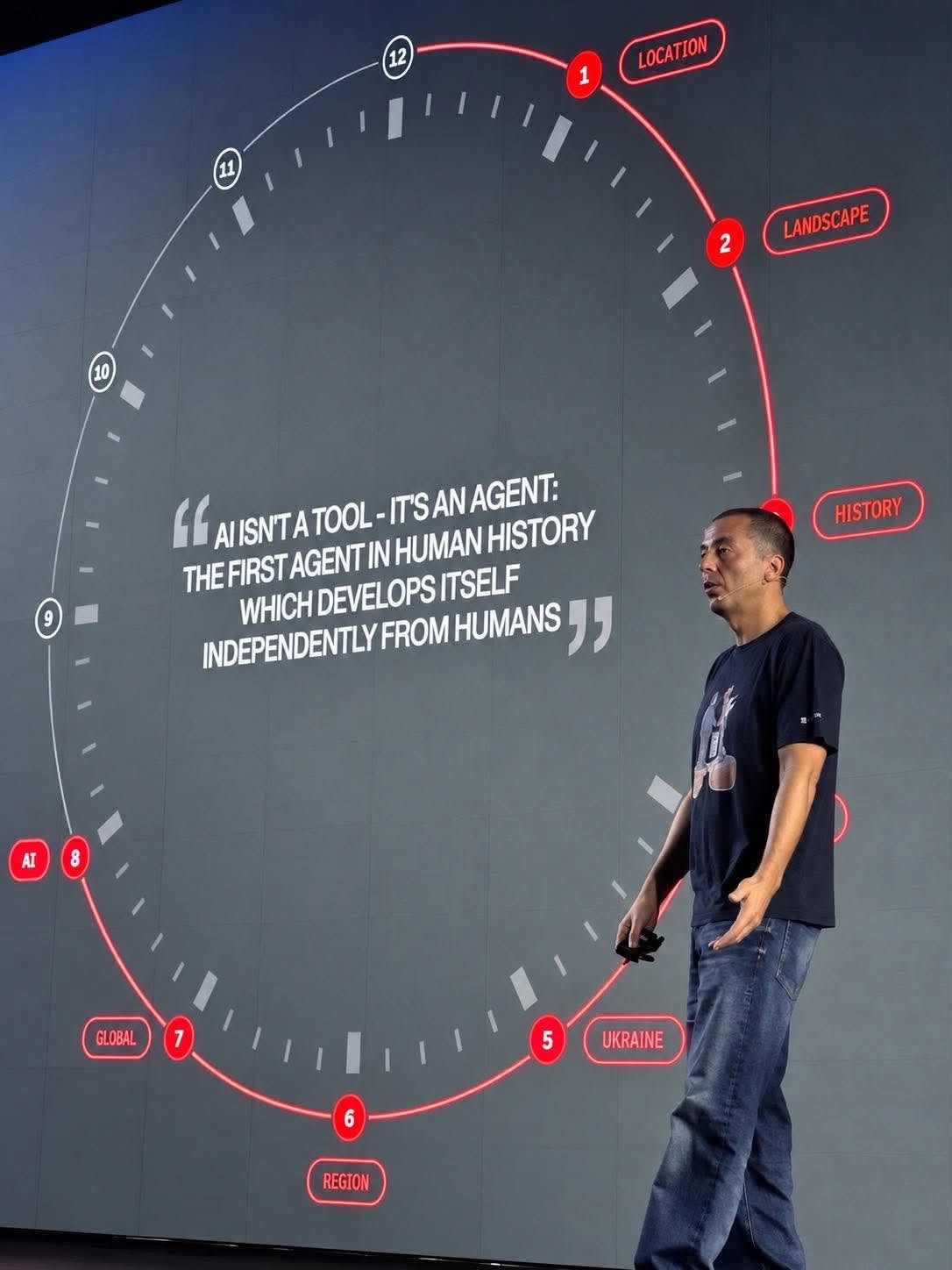
To illustrate the speed of change, he referenced the widely circulated AI-generated footage of Will Smith eating spaghetti. In his account, the distance between early experiments and increasingly convincing imagery demonstrated how quickly creative assumptions could become outdated.
For people making images, films and campaigns, that acceleration adds another layer of uncertainty. The tools are changing while the work continues, and the consequences reach into both production and the wider question of human creative agency.
Kavtaradze placed this technological shift alongside the other pressures in his speech. Each contributes to the feeling of working at a boundary whose position is constantly moving.
The pressure inside the brief
Eventually, that expansive view narrowed to something familiar to almost everyone in the room: the creative brief.
Whether working at an agency, within a brand or in production, Kavtaradze observed, people gather around a brief to make something happen. It is where ambition encounters the practical demands of the job.
He listed the pressures: client approval, audience response, taste, budgets, deadlines and the possibility of failure. All arrive alongside the demands of everyday life and a changing industry.
Then he identified the feeling that keeps the process moving.
“But at the same moment you get this feeling that something can be brilliant.”
That possibility became a turning point in the speech. After examining the forces that make life on the edge difficult, Kavtaradze considered what draws creative people towards it: the chance that an uncertain idea might become something worth making.
His remarks acknowledged both the strain of creative work and the attraction that survives it. Even within a restrictive brief, there remains a moment when an idea begins to feel possible.
Finding purpose in the work
In the closing section, Kavtaradze turned towards the individual.
Everyone in the room, he suggested, experiences these pressures through a personal life with its hopes, mistakes, highs and lows. Finding a place within that uncertainty requires an awareness of how the world affects us and how we respond.
He described the experience of becoming so absorbed in an activity that time seems to disappear. In that state of flow, he suggested, passion can find a connection with purpose.
It was a quieter ending to a speech that had travelled through history, politics, technology and the demands of the industry. The focus settled on the relationship between a person and their work, and on the conditions that allow something meaningful to emerge.
“And that’s the purpose of this festival,” Kavtaradze said, “to help each other to get the flow.”
For Ad Black Sea, the anniversary became an opportunity to consider what a creative gathering can offer its community. Alongside celebrating achievement, it can make room for difficult conversations, shared uncertainty and renewed purpose.
Kavtaradze’s closing invitation was to help one another find that purpose and, through it, the possibility of making work that people notice and love.