For years, the advertising industry has behaved as though technology platforms were forces of nature. Facebook changed the rules, and brands adapted. Instagram changed the format, and agencies adapted. Snapchat arrived, TikTok followed, algorithms became more demanding, and marketers learned another vocabulary, another set of dimensions, another definition of engagement. Now artificial intelligence has entered the picture, and much of the industry is once again asking the same question: what do the platforms want from us?
Cindy Gallop thinks advertising has been asking the wrong question. Speaking at Ad Black Sea, Gallop argued that the industry has spent decades surrendering power to technology companies that, economically, depend on advertising far more than advertising depends on any single platform. “We have completely lost sight of one very fundamental thing, which is, we are the business model of the internet,” she told the audience.
Her point was less about nostalgia for a pre-platform advertising world than about leverage. Silicon Valley may have built the infrastructure, feeds, algorithms and distribution systems that now shape much of modern marketing, but those businesses became enormously valuable because brands were willing to spend money inside them. “Mark Zuckerberg does not have his billions without advertising,” Gallop said. “None of the Silicon Valley tech bros would be as rich as they are today without advertising. And we’ve given away that power.”
It is a provocative argument because the relationship between advertising and technology has gradually come to feel almost inevitable. Agencies speak about optimizing for platforms. Brands build content systems around algorithms. Creative ideas are shortened, reformatted, multiplied and adjusted according to whatever a particular feed currently rewards. The result, Gallop suggested, is an industry that often behaves more like a supplier than a customer.
For her, the power dynamic should be reversed. “We have the power to say, ‘We’ve got what you need: money. You only get our money if we get to tell you what we do on your platforms.’”
When platforms start dictating the creative
Gallop pointed to a familiar tension in contemporary marketing. Brands are increasingly expected to produce large quantities of content tailored to individual platforms while still maintaining a coherent identity. The question is not whether brands should understand how platforms work. Of course they should. The problem begins when platform logic becomes the dominant creative logic.
If Instagram rewards one type of content, brands make more of it. If TikTok favors another, creative teams adjust again. If an algorithm appears to prioritize outrage, conflict or hyperactive engagement, marketers are tempted to follow. Gallop’s frustration is with how quickly those pressures become accepted as strategy. “The brands are the ones giving their money,” she said. “Why the hell are brands being pressured to do something they don’t want to do?”
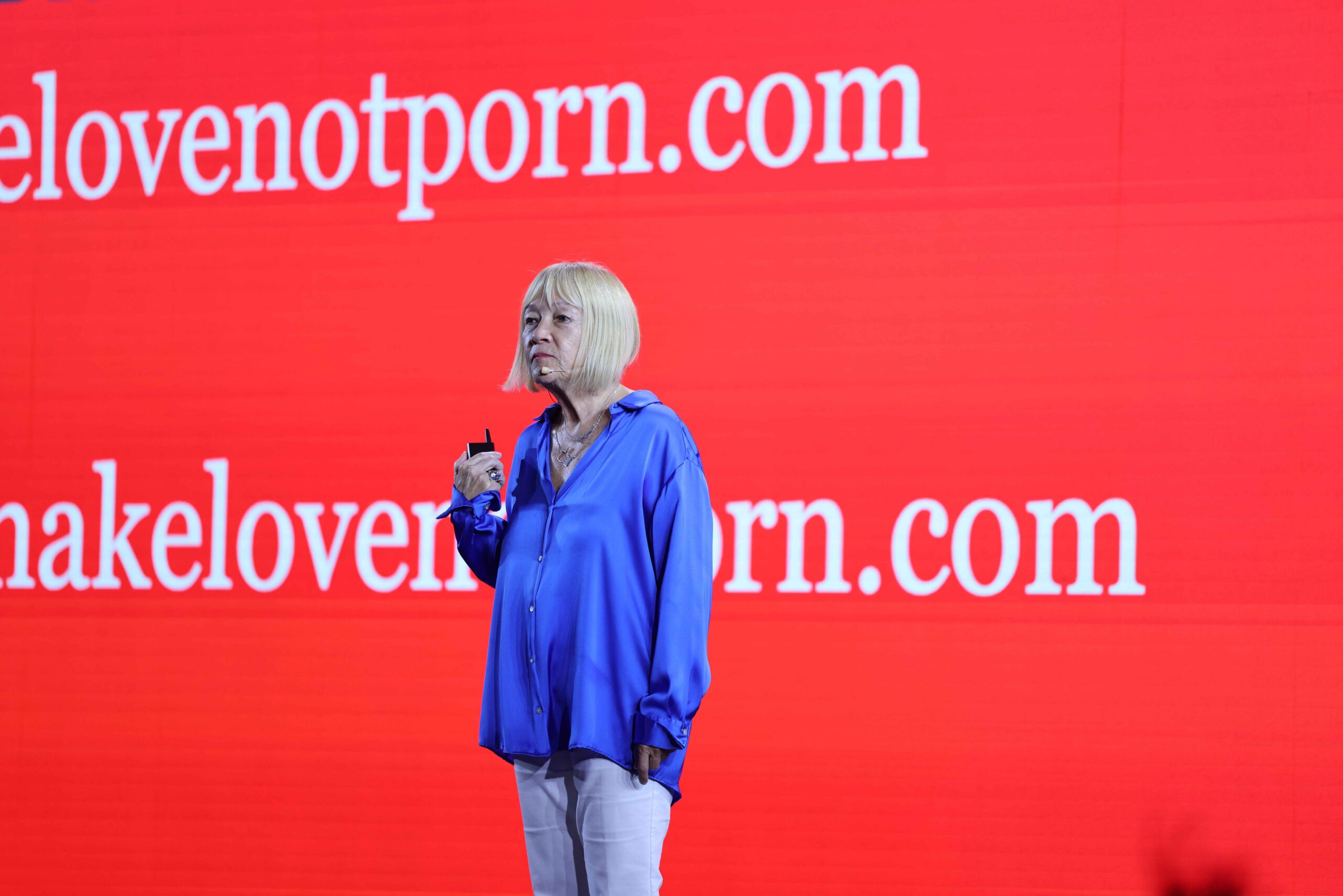
In her view, the industry should be arriving at platforms with creative ideas of its own rather than continuously reshaping those ideas according to whatever the platform happens to prioritize. “We are creative, and we have creative ideas for how we want to use your platform.”
That distinction matters because platform optimization is rarely neutral. Algorithms influence what gets seen, what gets rewarded and, inevitably, what gets made. When advertisers allow those incentives to dictate creative decisions, the industry risks producing increasingly similar work designed less around what people might enjoy and more around what machines are likely to distribute. Gallop’s criticism is ultimately about confidence. Advertising once saw itself as a cultural force capable of making ideas desirable. Today, much of it appears preoccupied with satisfying systems it did not design.
Brand safety should mean more than protecting the brand
Gallop also wants advertisers to rethink another phrase that has become routine in marketing conversations: brand safety. Traditionally, brand safety has meant preventing advertising from appearing beside disturbing, controversial or inappropriate material. Gallop believes that definition is too narrow. “What brand safety should really mean is: we demand better.”
For her, brands should use their financial influence to demand safer digital environments for the people they are trying to reach. “If you want our advertising billions, you stop running child sexual abuse ads. You keep young people safe on your platforms. We demand brand safety for our consumers.”
It is a significant shift in framing. Instead of asking whether a platform is safe enough for a logo, Gallop is asking whether it is safe enough for the person looking at that logo. That turns advertising spend into something more than media budget. It becomes leverage.
Gallop believes the same principle will become even more important as AI products spread through culture and business. Her concern is not simply whether advertisers will use artificial intelligence effectively. She is interested in who builds those systems, whose experiences shape them and what happens when the same narrow perspectives repeatedly determine how technology operates.
Throughout her talk, she returned to an argument she has made for years: industries create better products when more kinds of people are involved in creating them. For Gallop, this is both a social argument and a commercial one. “There’s a huge amount of money to be made out of taking women seriously.”
Her broader criticism of AI mirrors her criticism of advertising platforms. Technology should not be treated as something inevitable that marketers must simply accommodate. Companies funding these systems can help determine what kind of systems they become.
The algorithm is not the audience
One of the most revealing parts of Gallop’s argument came when she discussed AI-generated and engagement-driven content. The temptation for advertisers is obvious. If a particular type of story, creator or controversy generates attention, there is pressure to reproduce it. Generative AI makes that reproduction faster and cheaper than ever.
But Gallop warned against confusing algorithmic performance with creative value. “Do not do this. Do not subscribe to, ‘Oh, as long as they look like a real influencer, let’s do these sorts of things.’” Her criticism was directed at a wider culture in which brands can become increasingly comfortable manufacturing engagement because engagement itself has become the goal. “This is what the algorithm favors, which is engagement,” she said. “Rage engagement is everywhere.”
The danger is that advertising starts adopting the worst instincts of the internet simply because they produce measurable reactions. Clickbait, rage bait and synthetic personalities may generate numbers, but Gallop’s argument is that advertising has always had a fundamentally more optimistic mechanism available to it.
“Advertising is a good thing,” she said. “Because when you think about it, every single ad you see is a very positive thing, because every ad contains a problem and a solution.”
That may sound almost idealistic in an era when people install ad blockers, skip commercials and complain about being followed across the internet. Yet Gallop sees precisely that hostility as evidence that advertising has moved too far away from its original creative proposition. “Just be fucking brilliant at advertising,” she told the audience.
It was one of the simplest lines in the talk, and perhaps the one that best summarized her position. Advertising does not need to become less visible, more disguised or more algorithmically optimized. It needs to become better.
“People hate our advertising in general, but they love our ads”
Gallop recalled a line she heard years ago from someone working in advertising: “People hate our advertising in general, but they love our ads.” The contradiction stayed with her. People often complain about advertising as a category while still loving individual campaigns, quoting commercials, sharing branded films, remembering slogans for decades and building emotional relationships with brands.
For Gallop, the future of advertising depends on closing that gap. “It is important to the future of this industry that we have people love us in general.” That requires more than producing better creative. It requires reconsidering how advertising treats attention.
Gallop pointed to the countless digital advertising experiences built around coercion: countdowns, forced viewing, skip buttons and messages effectively telling audiences that they can escape after a few more seconds. Those formats communicate something uncomfortable about what the industry thinks of its own work. If advertising must trap someone for five seconds to make them watch it, it has already admitted defeat.
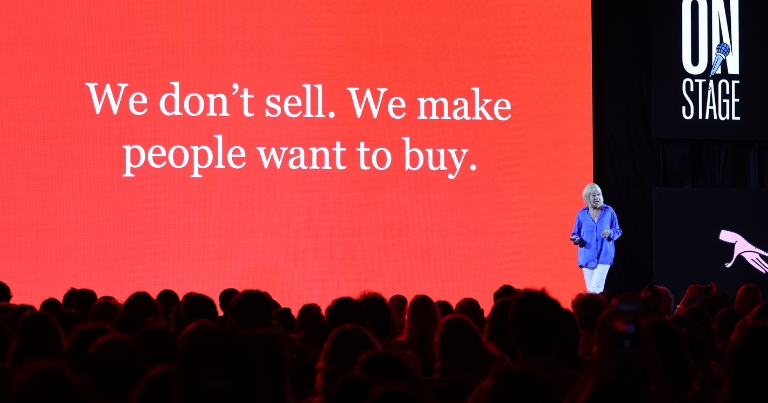
The alternative Gallop proposes is almost old-fashioned in its simplicity: make something people genuinely want to experience. That idea connects with one of her favorite advertising principles from her time at BBH. “We don’t sell. We make people want to buy.”
The difference is crucial. Selling is an action taken by a company. Wanting is an emotion created inside another person. The most powerful advertising, in Gallop’s view, has always operated in that second space. And that is exactly why she believes the industry should be more confident in its relationship with technology.
Platforms can distribute culture. Algorithms can rank it. AI can generate enormous quantities of it. But none of those things automatically create desire. Advertising can.
Advertising should set the terms again
Gallop’s argument is not that brands should abandon Meta, TikTok, Instagram, YouTube or emerging AI platforms. Nor is she suggesting the industry can simply ignore the technical realities of digital media. Her argument is more fundamental. Advertising should remember that it is participating in these ecosystems as a customer with enormous economic influence, not as a grateful guest.
Platforms want advertising money. Brands want access to audiences. Both sides need something from the other. For much of the past two decades, however, Gallop believes the relationship has been treated as though only one side held the leverage.
That has consequences beyond media buying. It influences the creative work brands make, the metrics marketers prioritize, the technology they normalize and the online environments consumers are expected to inhabit. Gallop wants advertising to become more demanding: demand better creative conditions, demand safer platforms, demand technology that serves more people, and demand room for ideas that were not designed solely to please an algorithm.
Most importantly, she wants the industry to stop approaching every new technological shift with the assumption that advertising must reshape itself around someone else’s rules. The industry, after all, helped finance the digital economy that now dictates so much of its behavior.
“We’ve given away that power,” Gallop said. Her message at Ad Black Sea was that advertising can take it back.