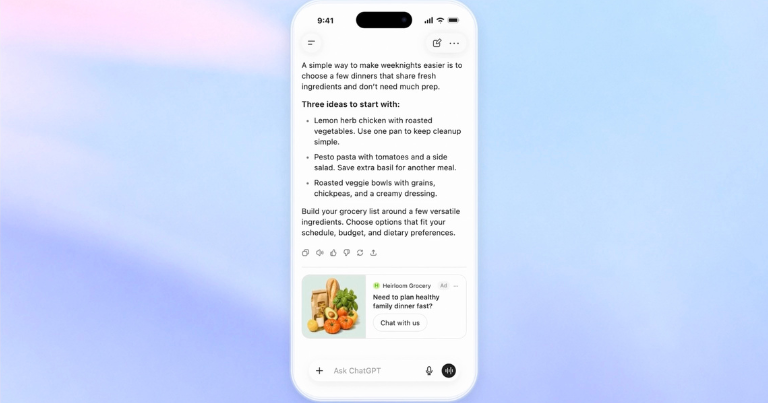
The company has introduced a new set of tools for ChatGPT Ads that push advertising deeper into the conversational experience. The most notable is Sponsored Agents, a format that allows someone who sees an ad to open a separate conversation with an AI representative of the advertiser and ask questions before deciding whether to visit the company’s website.
For a shopper, that could mean seeing a dining table in an ad and immediately asking whether it fits a particular room, how many people it seats or how difficult the material is to maintain. For the advertiser, the interaction creates space between awareness and purchase that conventional formats usually hand over to a landing page.
Sponsored Agents are clearly labeled and kept separate from ChatGPT’s independent responses and from the conversation the user was already having. They are currently being tested with a limited group of advertisers in the United States.
The format points to a larger change in how advertising may work inside AI products. Search advertising became powerful because it captured intent at the moment someone typed a query. Conversational interfaces contain even more context: users explain what they need, refine preferences, compare alternatives and ask follow-up questions. An ad placed inside that environment can potentially become part of a longer decision process.
Campaign Management Moves Into the Conversation
OpenAI is also bringing the same conversational logic to the advertiser side.
Marketers can now use natural-language prompts through the Ads Manager plugin in ChatGPT to build, edit and analyze campaigns. A website or campaign brief can become the starting point for an ad, while performance data can be queried conversationally and used to generate recommendations for what to change next.
Ads Manager is gaining generative creative tools as well. Advertisers can receive suggested copy and imagery based on their landing page and campaign objectives, then review and edit the material before using it. An optional text-customization feature can adapt existing headlines and descriptions to the context of a user’s conversation and translate copy into the user’s preferred language.
That creates a different relationship between AI and campaign production. Instead of opening separate tools for briefing, copywriting, asset creation, optimization and reporting, more of that work can happen through a single conversational interface.
The implications are especially interesting for smaller marketing teams. Campaign creation has traditionally required familiarity with advertising dashboards, targeting structures and reporting systems. Natural-language controls reduce some of that operational barrier, allowing marketers to describe what they want to accomplish rather than navigate every step manually.
Human review remains part of the process. Suggested creative is presented for approval and editing before it enters a campaign, leaving the advertiser responsible for what ultimately runs.
ChatGPT Ads Moves Into Shopify and HubSpot
The other significant part of the strategy happens outside ChatGPT itself.
OpenAI has selected HubSpot as its first CRM integration for ChatGPT Ads and Shopify as its first ecommerce partner. Businesses using HubSpot can connect their ads account, create campaigns, monitor results and follow up with leads without moving customer data into a separate workflow. Shopify merchants in the U.S. can connect product catalogs and commerce data directly to ChatGPT Ads, with international availability planned for markets where the advertising product operates.
The Shopify integration is particularly important for product advertising. Inventory and catalog information can stay synchronized with the merchant’s store, while commerce events feed back into measurement. The distance between product catalog, campaign creation and conversion tracking becomes considerably shorter.
HubSpot addresses another part of the funnel. A conversation or campaign that produces a lead can flow into the CRM, where businesses can continue the relationship using the customer context they already have.
Together, those integrations reveal the broader ambition behind ChatGPT Ads. OpenAI is building beyond a place where companies buy impressions. It is connecting advertising with the systems businesses already use to manage products, customers and sales.
What Happens When an Ad Can Answer Back?
Sponsored Agents may ultimately be the most significant experiment because they change one of advertising’s oldest limitations.
Most ads can show, tell or persuade. They cannot respond when someone has a specific objection.
A person interested in a piece of furniture may want exact dimensions. Someone considering a subscription may need to understand cancellation terms. A shopper comparing products may care about one feature the campaign never thought to mention. Traditionally, each of those questions pushes the customer toward another page, search or customer-service interaction.
A conversational ad can keep that curiosity inside the same experience.
That also raises the importance of transparency. OpenAI is separating Sponsored Agent conversations from its independent responses, making clear that the agent represents the advertiser. The distinction matters in an environment where people may otherwise assume every answer comes from the same neutral assistant.
For marketers, the opportunity is clear: advertising can become more responsive to individual questions and contexts. The challenge will be maintaining the line between useful product assistance and a sales conversation that feels intrusive or overly optimized.
The ad industry has spent decades learning how to win attention in feeds, search results and video. AI introduces another surface, one where consumers are already explaining what they want in remarkable detail.
The next question is what brands do once the ad starts talking back.