Every era of mass media has produced a handful of figures who did not just appear in the medium but taught it something about itself. Dolly Parton was one of the rare few who did this across every medium in turn: radio, television, film, cable and the internet; and the reason her influence traveled so far is worth examining on its own terms, apart from the songs.
Start with the core insight, because everything else follows from it.
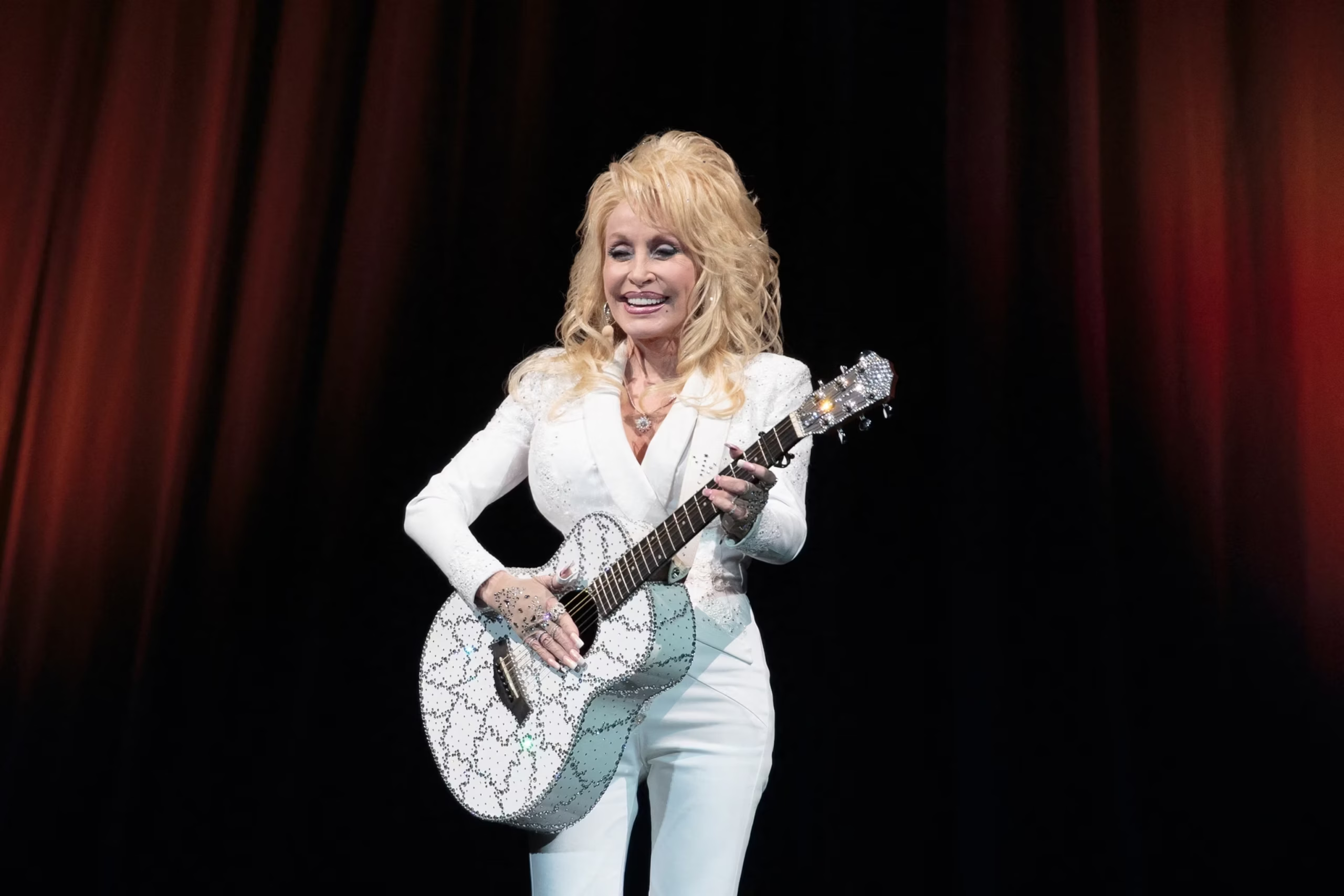
Parton understood, decades before the vocabulary existed, that a public figure is a piece of media: an image that gets copied, circulated, quoted, and remixed by other people. Most performers treat their persona as a byproduct of their work. She treated it as work. The wigs, the exaggerated figure, the rhinestones, the one-liners delivered with perfect timing, this was a deliberately built interface, engineered to be legible at a glance and impossible to confuse with anyone else. In an attention economy that would not be named for another fifty years, she had already solved its central problem: how to be instantly recognizable in any format, at any resolution, in any country.
This is why she scaled across the media the way she did. Radio carried her voice, and her songwriting gave it something to carry: “Jolene” and “I Will Always Love You” are structurally simple enough to survive translation, cover versions and cultural distance. Television needed personalities who could hold a camera’s attention while saying very little of substance, and she supplied one who could hold it while saying a great deal. Her line, that it costs a lot of money to look this cheap, is a media theory disguised as a joke: she was narrating her own construction to the audience, which made them collaborators in the image rather than passive consumers of it.
Film globalized her. “9 to 5” put her in front of audiences who had no relationship to country music, and the theme song detached from the film and became a labor anthem sung in workplaces that had never heard of Nashville. Then Whitney Houston’s 1992 recording of “I Will Always Love You” performed the ultimate act of media travel: a song written by a white Appalachian woman became, in another woman’s voice, one of the best-selling singles in the history of the world, played across continents that could not have located Tennessee on a map. Parton’s authorship traveled with it, quietly, everywhere.
The internet is where her method became fully visible, because the internet rewards exactly what she had always done. Platforms run on recognizable, repeatable, remixable images, and Parton had spent sixty years being precisely that. A generation that never bought a record met her as a meme and adopted her wholesale. When she posted the four-panel “Dolly Parton Challenge” in 2020, a different self for LinkedIn, Facebook, Instagram, and Tinder, it read as a light joke, but it was also a complete and accurate description of how identity now works online, delivered by someone in her seventies who had been performing multiplied selves since the 1960s. The platforms had finally built the machine she had been operating by hand for decades.
What makes her a genuine case study rather than a lucky one is the consistency of the signal. Media figures are usually shaped and then dated by their technology, bound to the decade that made them. Parton reversed the current. Each new medium arrived; she read what it wanted, adjusted the costume, and stayed unmistakably the same underneath. The image never fragmented, never contradicted itself, never needed a reinvention tour. That coherence is why her brand could support a theme park, a publishing empire, a book-donation program mailing hundreds of millions of copies, and a philanthropic reputation, all resting on the same recognizable foundation without any one part undermining the others.
And she did it while keeping control. She wrote her own songs and, unusually for a woman in Nashville in her era, held onto her own publishing, which meant she owned the media she generated rather than renting it out. She guarded her private life behind a wall so well-constructed the public rarely noticed it was there. The persona was open and endlessly available; the person behind it was not. That split, total visibility of the image, total privacy of the self, is the discipline most modern celebrities fail at, and she maintained it for six decades.
Her importance to worldwide media, then, is not that she was famous in many places, though she was. It is that she independently arrived at the operating logic that now governs the entire attention economy, build a legible, consistent, remixable image; let the audience become its distributors; own what you make; and keep the real self out of frame, and she demonstrated that this logic could be run for a lifetime without cynicism, because underneath the constructed image the generosity was real. She is the closest thing popular culture has to a proof of concept: evidence that a single, carefully engineered public self can move intact through every medium the twentieth and twenty-first centuries invented, and lose nothing in translation.
The machinery of fame kept changing. She treated all of it as a wardrobe. That is the lesson the media world is still catching up to.