From carved turnips and neighborhood pranks to limited-edition candy and billion-dollar costume sales, Halloween may be one of marketing’s strangest success stories.
Imagine trying to sell Halloween to someone who has never heard of it. For one night, people decorate their homes with fake cobwebs, spend money to make themselves look dead, give free candy to children who knock on their doors, carve faces into vegetables and willingly pay to enter buildings where strangers are hired to frighten them. Restaurants make food look radioactive, beauty brands release products in colors associated with bruises and blood, supermarkets fill entire aisles with plastic skeletons, and even dogs are expected to participate.
Presented like that, Halloween sounds like a difficult pitch. Yet it has become an extraordinarily durable commercial ritual. In the United States alone, Halloween spending was expected to reach a record $13.1 billion in 2025, covering costumes, decorations, candy and cards. By early August 2026, one-quarter of consumers surveyed by the National Retail Federation had already bought at least one Halloween item, even though the holiday itself still falls on October 31.
The interesting part is how naturally commerce attached itself to the holiday. Halloween was never invented by a retailer, a confectionery company or an advertising agency. Its commercial infrastructure grew around traditions that were already unusually compatible with marketing: disguise, storytelling, collecting, decorating, indulgence, novelty and social participation. Long before anyone was designing Halloween packaging, people were already behaving like perfect Halloween consumers.
Before the pumpkin, there was a turnip
Halloween has accumulated so many traditions over centuries that looking for a single origin is almost impossible. Many of its customs are commonly connected to Samhain, a Celtic festival marking the end of summer and the beginning of the darker part of the year. Folklore associated the period with a thinning boundary between the living and supernatural worlds, while food could be left as an offering and disguises were used in customs intended to protect people from wandering spirits. Later Christian observances around All Saints’ Day and All Souls’ Day mixed with regional traditions, eventually producing what became known as All Hallows’ Eve.
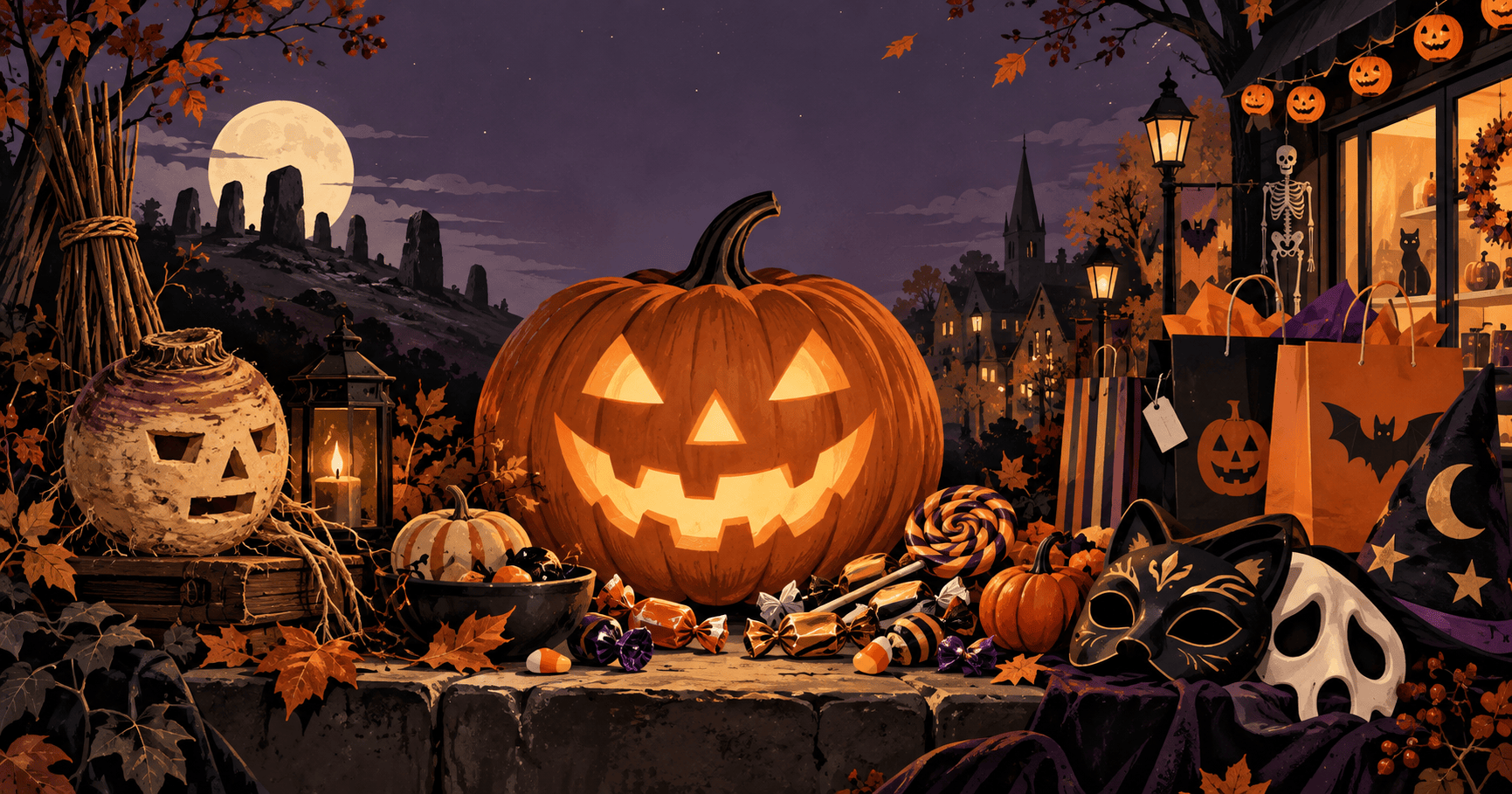
Some familiar Halloween symbols looked considerably less photogenic in their original form. In Ireland and other parts of the British Isles, people carved frightening faces into turnips and other root vegetables, sometimes placing lights inside them. Irish immigrants arriving in the United States encountered pumpkins, which were larger, softer and much easier to carve. The unpleasant-looking turnip gradually lost its place to the pumpkin, and one of Halloween’s most recognizable visual symbols was born through a surprisingly practical substitution.
That small change says a lot about Halloween’s later commercial strength. Its symbols have always been flexible enough to change material, geography and meaning while keeping their emotional identity intact. A protective lantern became seasonal décor, and a folk object became something that could be reproduced, customized, photographed and sold every October.
Trick-or-treating was once far less polite
Modern trick-or-treating feels almost aggressively wholesome. A child dressed as Spider-Man says three words, receives chocolate and moves to the next house, while the adults admire the costume and pretend not to notice that the child has already eaten six pieces of candy.
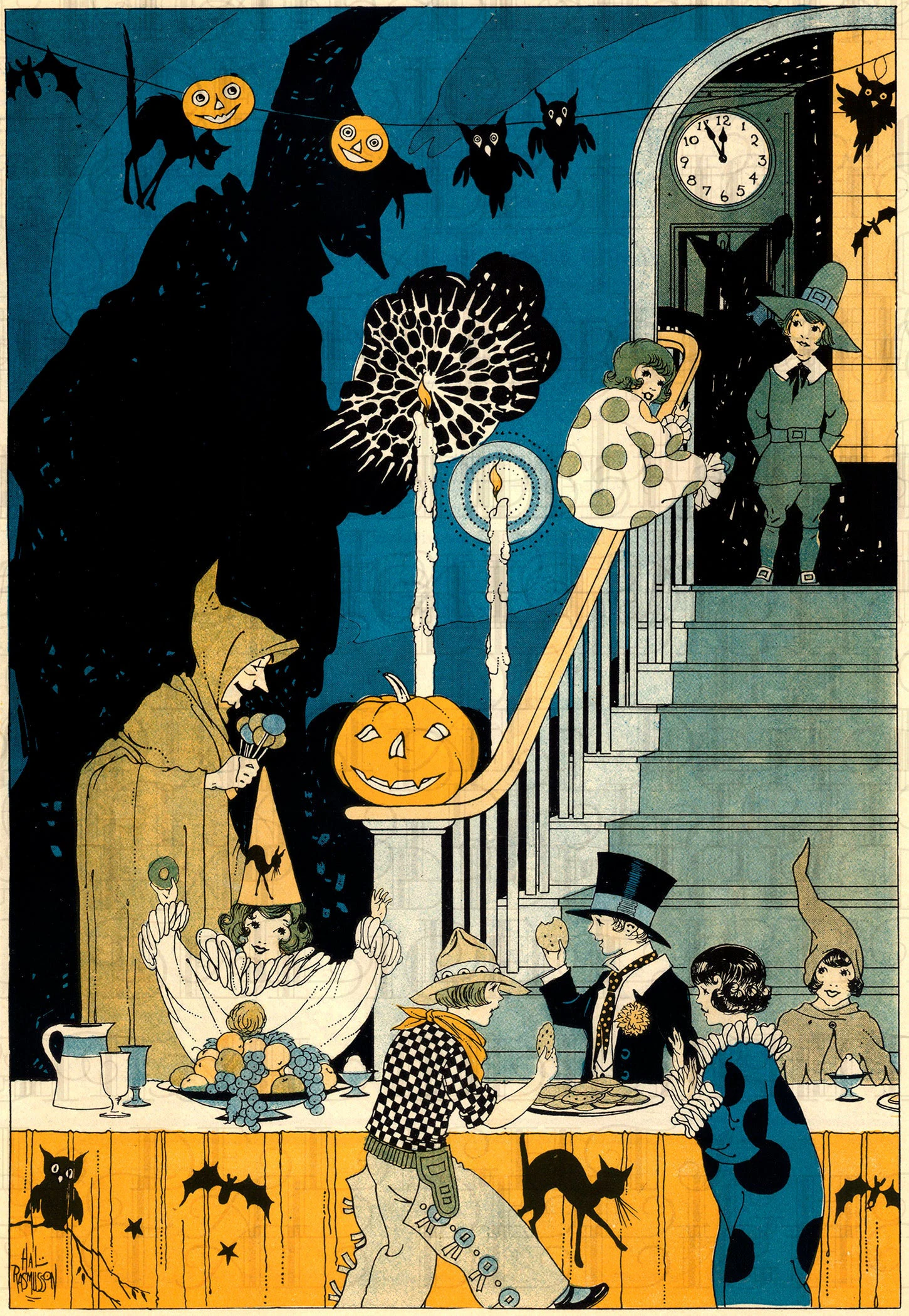
Earlier American Halloween customs could be substantially more chaotic. By the late nineteenth and early twentieth centuries, seasonal mischief sometimes involved vandalism, property damage and elaborate neighborhood pranks. Ropes could be stretched across sidewalks, windows were soaped or rattled, objects were overturned, and what began as seasonal entertainment occasionally became expensive enough for communities to start looking for ways to tame the holiday.
One of the solutions was remarkably simple: give the children something. Versions of trick-or-treating gained popularity in the United States during the first half of the twentieth century and expanded dramatically after World War II. Growing suburbs made door-to-door visiting easier, sugar rationing had ended and households needed something convenient to hand out.
Candy was not always the automatic choice. Children could receive homemade cookies, nuts, coins, toys and other small treats, while companies experimented with all kinds of Halloween giveaways. Candy manufacturers became more aggressive about promoting Halloween during the 1950s, and individually wrapped sweets had obvious advantages: they were cheap, portable, branded, portioned and easy to distribute.
Over time, a vague social obligation to give visiting children something became attached to one highly specific product category. Today, handing out candy barely feels like buying a consumer product. It feels like participating correctly in Halloween, which is a far more powerful position for a brand or category to occupy.
Then Halloween discovered pop culture
Costumes introduced another commercial advantage: Halloween could absorb whatever happened to be popular that year. A ghost costume can survive for centuries, while Barbie, Wednesday Addams, a blockbuster superhero, a viral meme or a video game character can dominate one October and disappear by the next. The holiday can accommodate all of them without changing its basic structure.
That gives Halloween an unusual balance between repetition and novelty. Witches, vampires, skeletons and ghosts provide a permanent visual vocabulary, while popular culture refreshes the costume aisle every year. In a way, Halloween has built trend forecasting into its own traditions, because every October reveals which films, celebrities, memes and characters have become culturally unavoidable.
It also turns identity into a product for one night. For most of the year, clothing is expected to say something relatively consistent about who we are. On Halloween, people pay for temporary identities precisely because those identities disappear the next morning. A costume only needs to make sense for one party, one photograph, one joke or one cultural moment.
That logic has spread beyond humans. In 2025, 23 percent of U.S. consumers surveyed by the National Retail Federation said they planned to dress up their pets for Halloween. Somewhere along the way, an ancient tradition involving disguise and spirits evolved into a dachshund wearing a hot-dog costume, which may be one of the clearest signs that a ritual has reached commercial maturity.
Halloween gives brands permission to behave strangely
October temporarily changes the rules of good taste. Food can be black, purple or slime-green, packaging can be covered in skulls, a beauty product can resemble a potion and a supermarket can turn its displays into miniature cemeteries. Ordinary products suddenly acquire names involving death, monsters, curses and blood without triggering the usual panic inside a brand department.
Few mainstream commercial moments offer brands such broad permission to distort their own identity. Halloween lets familiar products become slightly absurd, grotesque or theatrical for a few weeks, and consumers already understand the joke. A brand does not need to establish a long-term relationship with vampires. It can be obsessed with vampires for three weeks and quietly return to normal in November.
That freedom also makes Halloween perfect for limited editions. Orange filling, black packaging, ghost-shaped cookies, glow-in-the-dark bottles and seasonal flavors can appear without requiring much explanation. Their short lifespan is part of the attraction, and consumers already know that Halloween products are supposed to disappear.
Scarcity therefore becomes part of the entertainment. The product arrives, circulates through social media, becomes collectible or photographable, disappears and can return twelve months later with very little effort. The annual cycle gives brands urgency without forcing them to invent an entirely new idea every year.
Why Halloween keeps starting earlier
Retail has gradually stretched Halloween far beyond October 31. Pumpkins begin appearing while people are still wearing summer clothes, costume sections open weeks in advance and decorative skeletons spend much of September staring at shoppers who came in for something completely unrelated.
More time to sell obviously helps retailers, but consumer behavior suggests that the shift is also driven by anticipation. In 2025, nearly half of U.S. Halloween shoppers started shopping in September or earlier, with many citing excitement about fall, fear of missing desired products and a wish to avoid last-minute shopping. By early August 2026, one-quarter of surveyed consumers had already bought something for Halloween.
The holiday has gradually expanded from a date into a seasonal atmosphere. That is commercially much more valuable, because one evening can support only so many purchases, while a six- or eight-week season can sustain home décor, fashion, beauty, food, drinks, events, entertainment, travel and social content.
Decoration may show this transformation most clearly. In 2025, 78 percent of U.S. Halloween shoppers planned to buy décor, and total decoration spending was expected to reach $4.2 billion. More people planned to buy decorations than costumes, suggesting that the house itself has joined the costume party.
People increasingly dress their homes for Halloween in much the same way they dress themselves. They choose an aesthetic, display it publicly, photograph it and share it online. A giant skeleton on a front lawn has almost no practical value, and that is exactly why it works: the purchase signals that the household is participating in the season.
Fear, but with an exit sign
Halloween also sells an emotion that most brands usually try to avoid: fear. Haunted houses, horror films and disturbing decorations invite people to experience discomfort voluntarily, but the risk is controlled. A scary movie has a running time, a haunted attraction has an exit and a costume can be removed whenever the experience stops being fun.
That controlled danger is easy to package commercially. People can buy a ticket, stream a film, book an event or purchase a product that gives them access to a temporary emotional state. The fear has clear boundaries, which makes it enjoyable rather than genuinely threatening.
Halloween also softens darker imagery through humor and exaggeration. Death becomes a dancing plastic skeleton, severed fingers become gummy candy and tombstones appear in suburban gardens beside delivery boxes. Frightening symbols become socially acceptable because they are turned into play, which gives brands enormous creative freedom.
A ritual that marketing learned to monetize
Halloween’s commercial success can look almost absurd when viewed historically. Ancient customs became seasonal aisles, folklore became packaging, candy companies helped turn a flexible tradition into a confectionery event and costume manufacturers learned to monetize popular culture. Retailers then stretched October 31 backwards into September and, increasingly, August.
Yet commercialization alone does not explain why the holiday continues to work. The underlying behaviors were already there. People wanted to disguise themselves, decorate spaces, tell frightening stories, gather in groups, exchange food and briefly behave differently from how they behaved the rest of the year.
Commerce eventually learned how to place products inside each of those behaviors. That may be Halloween’s most useful marketing lesson: seasonal products become especially powerful when buying them feels like participating in an existing ritual.
Centuries ago, someone might have left food outside for wandering spirits. Today, someone buys a 150-piece variety bag because neighborhood children might ring the doorbell.
The packaging changed considerably. The ritual of preparing for visitors did not.