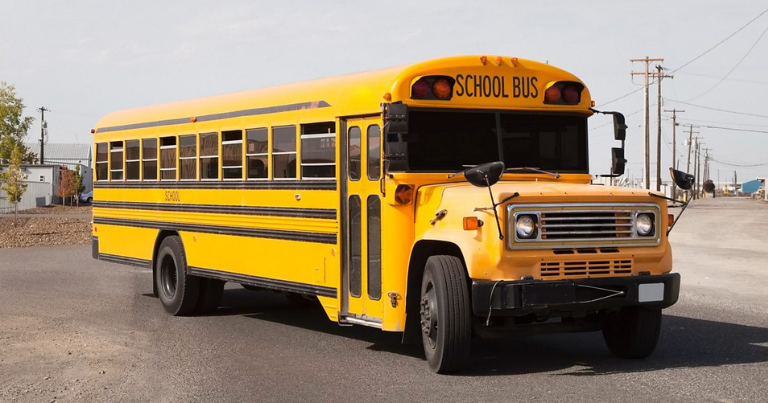
Few colors in America come with instructions. School bus yellow does.
For generations, the same deep yellow-orange has appeared outside suburban homes, along rural highways and in countless movies and television shows. It is so familiar that a glimpse of the color alone can summon an entire scene: backpacks, early mornings, folding doors, rows of vinyl seats and the unmistakable red stop sign swinging out into traffic.
Yet the American school bus did not always look this way. A century ago, children arrived at school in an assortment of vehicles that could be almost any color and, in some communities, were barely buses at all.
In the 1930s, educator Frank W. Cyr traveled around the country studying how students were transported. What he found was remarkably inconsistent. Children rode in conventional buses, converted trucks and, in at least one Kansas district, horse-drawn wheat wagons. Some school vehicles were painted red, white and blue. Manufacturers, meanwhile, had to accommodate different specifications from one district to the next, making standardized production nearly impossible.
Cyr decided the country needed a system.
In April 1939, he brought transportation officials, educators, engineers, manufacturers and paint specialists to Teachers College at Columbia University. The conference lasted seven days and produced 44 standards covering details such as bus dimensions, doors, aisle widths and ceiling heights.
The most enduring decision involved paint.
Dozens of yellow and orange samples were considered. The group eventually settled on the shade originally known as National School Bus Chrome, later renamed National School Bus Glossy Yellow. The slightly orange tone made black lettering particularly legible in the low light of early mornings and late afternoons, when children were most likely to be traveling.
There is still no federal law simply declaring that every American school bus must be yellow. Yet states adopted the standard so broadly that the color became effectively inseparable from the vehicle itself. Most of the other standards created in 1939 have been revised over the decades. The yellow survived.
Before the Yellow Came the Steel
The recognizable school bus was already beginning to take shape before Cyr’s conference.
In 1925, Georgia Ford dealer Albert Luce mounted a wooden passenger body onto a Ford Model TT truck for a customer who needed to transport workers. The rough local roads quickly exposed the weakness of the wooden construction. Luce became convinced he could make something sturdier.
By 1927, he had built a bus reinforced with a steel framework. That vehicle, Blue Bird No. 1, is now held by The Henry Ford museum and is considered the oldest surviving school bus in America. Luce eventually left the car-dealership business and devoted himself to building buses.
His timing was almost perfect.
Across rural America, thousands of small neighborhood schools were being consolidated into larger institutions serving wider areas. A child who once walked to a one-room schoolhouse might suddenly need to travel miles each morning. The school bus became the infrastructure that made that new educational geography possible.
In that sense, its rise tells a much larger story about America. The bus connected distant homes to centralized schools and helped reshape the daily lives of rural families. Later, during the battles over school desegregation, buses took on an entirely different political meaning as courts and school districts used transportation to move students across racially divided neighborhoods.
By the 1980s, yellow buses were carrying more than 60% of American students to school.
A Design That Teaches Drivers What to Do
Part of the school bus’s staying power comes from how little explanation it requires.
The yellow body identifies it from a distance. Black lettering creates strong contrast. Flashing red lights announce a stop. The mechanical stop arm tells approaching drivers exactly what is expected of them. Its shape, color and signals form a visual language most Americans learn long before they earn a driver’s license.
Over time, the vehicles gained padded seating, improved structural protection, mirrors and additional warning systems. Today, the National Highway Traffic Safety Administration describes school buses as among the safest vehicles on American roads and says less than 1% of traffic fatalities involve children traveling in school transportation vehicles.
That safety record makes the original 1939 color decision feel surprisingly modern. Cyr and his colleagues were practicing a form of design thinking before the phrase became fashionable: make an object immediately recognizable, reduce ambiguity and use visual cues to influence behavior.
The result became one of America’s most successful pieces of public design.
The Bus Changes. The Yellow Stays.
Today’s school bus is facing another transition. Electric models are entering fleets, transportation patterns are changing and driver shortages have made the familiar daily ride less available in some communities.
Yet the basic image has proved remarkably resistant to reinvention.
A new electric school bus can carry batteries, software and technology its 1920s predecessor could never have imagined, while still arriving in essentially the same yellow chosen before World War II.
That continuity helps explain why the school bus has moved beyond transportation and into American visual culture. It appears in childhood memories, back-to-school advertising, movies, cartoons and photographs as instant shorthand for growing up.
Millions of children have stepped through those folding doors without ever knowing the color was debated in a room at Columbia University nearly nine decades ago.
They did not need to know.
That was the brilliance of the design. Eventually, America stopped seeing a shade of yellow and started seeing a school bus.