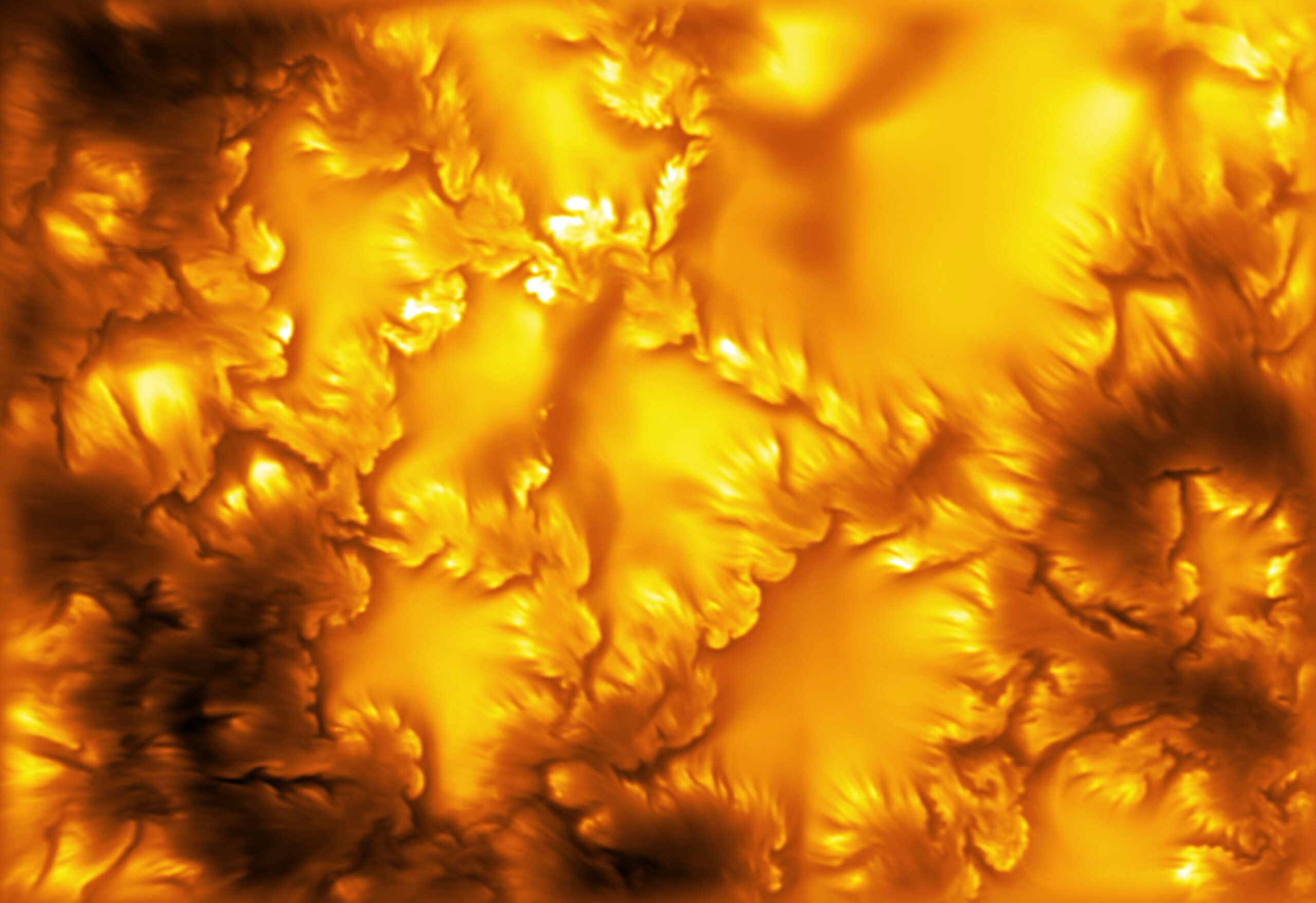
Astronomers have spotted something on the surface of the sun that physicists have been predicting for more than 150 years but had never actually seen. Using the world’s largest solar telescope, a team of researchers has captured direct images of tiny, swirling whirlpools tearing across the sun’s surface, and the discovery could finally explain how the sun builds up the explosive magnetic energy behind solar flares and the storms that occasionally knock out satellites and power grids on Earth.
The research, published Wednesday in Nature, comes from an international team working with the US National Science Foundation’s Daniel K. Inouye Solar Telescope on Maui, the most powerful solar telescope ever built. What they found are small-scale vortices known as Kelvin-Helmholtz instabilities, or KHI, a fluid dynamics phenomenon first described in the 1870s that shows up everywhere from ocean waves to the swirling cloud bands on Jupiter. Nobody had confirmed it happening on the sun until now.
What happened
The Inouye telescope, perched near the summit of the Haleakalā volcano, zoomed in on a magnetically active patch of the sun’s surface, the photosphere, at a resolution no instrument has managed before. Combined with computer simulations built by the NSF’s High Altitude Observatory and Germany’s Max Planck Institute for Solar System Research, the images revealed dozens of small whirlpool-like structures forming along the edges of magnetic regions, with an average spacing between vortices of just 50 to 65 kilometers. That is remarkably close between the real observations and the simulated ones, which is what let researchers confirm the phenomenon rather than just theorize about it.
KHI forms when two fluids or gases slide past each other at different speeds, creating a shear boundary where small disturbances snowball into spiraling vortices. On Earth, the same physics produces wave-like cloud formations and choppy water on a windy lake. On the sun, it appears to happen wherever the constantly bubbling surface, called granulation, rubs up against magnetic structures.
Why it matters
For decades, solar physicists have leaned on a theory called flux braiding to explain how the sun accumulates magnetic energy. Magnetic field lines twist around each other like braided hair until the tension becomes unstable, snap, and reconnect in a burst of energy, a process called magnetic reconnection. That reconnection is what powers solar flares and coronal mass ejections, the bursts of charged particles that can disrupt satellites, GPS signals, and power infrastructure when aimed at Earth.
What was missing was an explanation for why the twisting happens in the first place. This new discovery suggests KHI could be that missing engine. Because these vortices appear to be constant and widespread across the sun’s surface wherever the magnetic field is strong enough, researchers believe they may be quietly and continuously twisting field lines, feeding the flux braiding process that eventually erupts as solar storms.
The findings also touch a separate, decades-old puzzle: why the sun’s outer atmosphere, the corona, runs far hotter than the surface beneath it. According to the research team, the mixing effect created by these vortices helps push energy upward into the corona, offering a partial answer to why a layer of the sun that should be cooler than the surface below it is instead millions of degrees hotter.
The bigger picture
This is not just an astronomy curiosity. Space weather has become a genuine infrastructure risk as economies grow more dependent on satellites, GPS-timed financial transactions, and power grids sensitive to geomagnetic disturbances. The Carrington Event of 1859, still the benchmark for a worst-case solar storm, set telegraph stations on fire. A storm of similar strength today would hit a planet running far more of its economy through satellite links and precision electronics.
Better physical models of how the sun stores and releases magnetic energy feed directly into space weather forecasting, the same discipline that insurers, satellite operators, and grid operators increasingly rely on to assess risk. The Inouye telescope’s ability to resolve features at the scale of tens of kilometers on an object 150 million kilometers away is itself a milestone. It is the kind of instrumental leap that tends to unlock a wave of follow-on discoveries, not unlike what happened after the first high-resolution imaging of exoplanets or gravitational wave detections opened new fields of inquiry.
What’s next
Researchers say this is an early step rather than a finished picture. The next phase involves building automated detection tools that can catalog these vortices at scale across Inouye’s high-resolution data, rather than identifying them by hand. That should help quantify how much energy the vortices actually carry into the sun’s upper atmosphere, and how much they contribute to the diffusion of magnetic fields, a factor that current models of the sun’s roughly 11-year magnetic cycle still struggle to explain.
If the pattern holds, KHI could become a standard input in how physicists model not just our sun, but other stars, adding a fundamental piece to how scientists think about stellar magnetism generally.