A post can bring in thousands of new viewers while taking a brand further from the people it needs to reach. The numbers offer plenty of encouragement: more views, more comments, more reasons to repeat the format. What they may reveal much less clearly is whether anyone is developing an interest in the product.
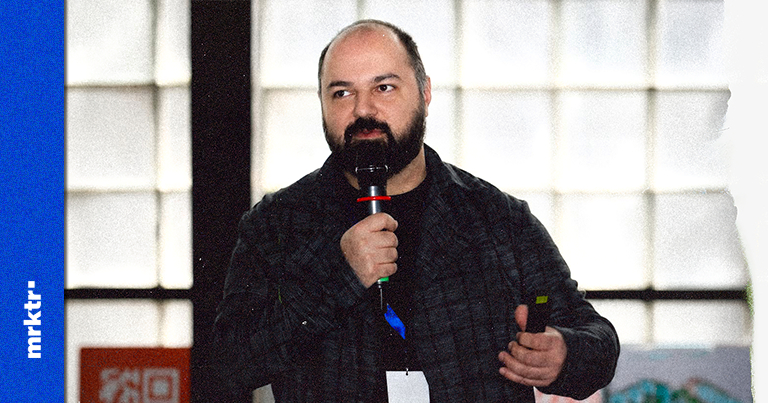
In this interview with marketer.uk, digital marketing specialist Aleksandre Chomakhidze discusses how he approaches that gap: deciding what deserves to be repeated, questioning familiar advice about attention spans, and assessing what happens after someone clicks. His starting point is the business objective and the audience. Platform mechanics come next, helping the content reach people without becoming the reason it exists.
M: When planning a content strategy, how do you balance what the audience cares about, what the platform rewards and what the business needs? Where do those priorities tend to clash?
I usually start with the business objective and the audience, then think about the platform. The algorithm matters because even a great message has limited value if nobody sees it. But I see it as a distribution system, rather than the customer.
Ideally, content brings together three things: something the audience cares about, something the platform can distribute effectively and something that moves the business towards a real objective.
The clash usually happens when visibility becomes the objective itself. A brand discovers that entertaining or controversial content gets reach, so it produces more of it. Engagement rises, but the connection between the content and the product becomes weaker.
At that point, I ask whether doubling the reach of this content tomorrow would actually help the business. If the answer is no, reach is probably distracting us from the real goal.
M: “That’s what the algorithm wants” is a familiar explanation in digital marketing. How do you distinguish useful advice from something everyone repeats?
I am sceptical whenever marketers talk about the algorithm as though it were one person with fixed preferences. Platforms change constantly, audiences behave differently, and what works for one account may fail completely for another. I want to know what evidence we actually have.
Where possible, I test assumptions through controlled experiments, looking at the format, opening seconds, headline, length, publishing time, call to action, creative style and distribution. I also avoid judging an experiment on a single post. One successful post can easily be luck.
Results often challenge conventional wisdom. Marketers sometimes become obsessed with making everything shorter because “people have no attention span”. Yet I have seen longer educational content outperform shorter pieces when the subject is useful to the right audience. People can give something their attention; they have very little patience for content that feels irrelevant to them.
M: When a post gets plenty of views and strong engagement, how do you know whether it reached the right people?
High reach is a signal, but it does not automatically tell you that something positive has happened for the business. I look at what follows the initial engagement: who is commenting and sharing, whether people visit the profile or click through to the website, and whether we see qualified enquiries, branded searches, saves or direct messages.
Even the language people use in comments can reveal whether the content has reached its intended audience. A post that reaches 500,000 people can still be less valuable than one that reaches 20,000 highly relevant people.
Marketers sometimes confuse attention with intent. Attention creates an opportunity for something else to happen, so I always want to understand whose attention we attracted and what happened afterwards.
M: When content underperforms, where do you start looking for the problem?
I normally work from the top of the funnel down. First, I look at whether people stopped and consumed the content at all. If they did not, there may be a problem with the hook, headline, thumbnail or opening seconds.
If people started watching or reading but dropped off quickly, I look at the execution: structure, pacing, clarity and whether the content delivered what the opening promised. If consumption is strong but reach is weak, distribution may be the issue.
When engagement looks healthy but subsequent actions are poor, I start questioning the audience or the relevance of the topic to the business.
I try not to change everything at once, because that makes it difficult to learn anything. Underperformance needs diagnosis before we jump to the conclusion that the algorithm killed the post.
M: Once a format performs well, how do you decide whether to keep repeating it or try something new?
If something works, I believe in repeating it. There is no prize in marketing for constantly reinventing something that already produces results. But it helps to understand which part is worth repeating.
A format may work because it answers a specific problem quickly. The fact that it happens to be a carousel or a 30-second video might be less important. Once you understand the underlying principle, you can use it in different formats.
The danger comes when a brand becomes dependent on one format and stops experimenting because the numbers look comfortable. I like to base most of the content on proven approaches while reserving some of the output for experiments. That lets you keep delivering results while testing what could work next.
M: A headline that overpromises might win an A/B test. Where do you draw the line between effective optimisation and damaging trust?
The content has to deliver on the promise that made someone click. A stronger headline can create curiosity, but if it sets an expectation that the product or content cannot realistically satisfy, it is borrowing performance from future trust.
You might improve the click-through rate today while damaging conversion rates, retention and brand perception later. One of the biggest mistakes in digital marketing is optimising individual metrics without considering what happens elsewhere.
I judge a headline by whether it attracts the right people and sets an accurate expectation, as well as by how many clicks it generates.
M: What makes a successful organic post a good candidate for paid media?
I see organic content partly as a learning environment. It helps us understand which topics, messages, hooks and creative ideas resonate naturally with the audience. With paid media, we are purchasing distribution, so the commercial objective and measurement become much more important.
A strong organic post can be a good candidate for an ad, but I would not automatically boost it because it received a lot of engagement. First, I want to understand why it performed.
I check whether it was relevant to the product, attracted the audience we want and prompted meaningful actions. I also consider whether the message will work for people who do not already follow the brand.
Sometimes the best-performing organic content is entertaining but commercially weak. A post with moderate organic engagement may become an excellent ad because its message is highly relevant to a particular audience segment.
M: When audience research and behavioural data point in different directions, how do you decide which to follow?
I usually give more weight to behaviour, but I try to understand the difference instead of simply dismissing the research. People are not always good at predicting how they will behave.
I have seen this particularly often with educational content. An audience may say it wants detailed or advanced information, while responding most strongly to content that solves one clear problem in a simple, practical way.
That does not necessarily mean people were dishonest in the research. The way we presented the more advanced information may have made it harder to engage with.
I generally treat audience research as a hypothesis and behavioural data as evidence. Both help me design the next experiment.
M: How do you explain to a client that fewer views can sometimes mean more value, especially when the effect on sales is difficult to measure?
I use a simple comparison. Imagine one piece of content reaches 200,000 people and generates almost no business action. Another reaches 15,000 but brings qualified website visits, enquiries and conversations with potential customers. Asking which one the client would prefer to produce again usually changes the discussion.
When direct revenue attribution is difficult, I look at supporting indicators: qualified traffic, profile visits, branded search, saves, shares, direct messages, lead quality, conversion rate, time on site and assisted conversions.
Context matters enormously. A B2B company selling a high-value service does not need millions of views. Reaching the right 500 decision-makers can make a campaign extremely successful. Lower reach can sometimes reflect a narrower, more valuable audience.
M: How do you build an audience relationship that can survive changes to a platform’s algorithm?
Social platforms are rented distribution. You can build a huge audience there, but you do not control the algorithm, the rules or even your access to that audience.
I want social media to create attention and for some of that attention to move into channels the brand controls more directly. The website is the central asset because it is where the brand controls the experience, the information and usually the conversion.
Search is valuable because it captures existing intent. Someone discovering you on social media and someone searching specifically for your product are in different frames of mind. Email gives the brand a direct communication channel that is far less dependent on algorithmic distribution.
My aim is to use the algorithm to reach people while building a relationship that can survive without it. We create content for people, and we learn how algorithms distribute it. Once those priorities are reversed, marketing starts becoming very strange.