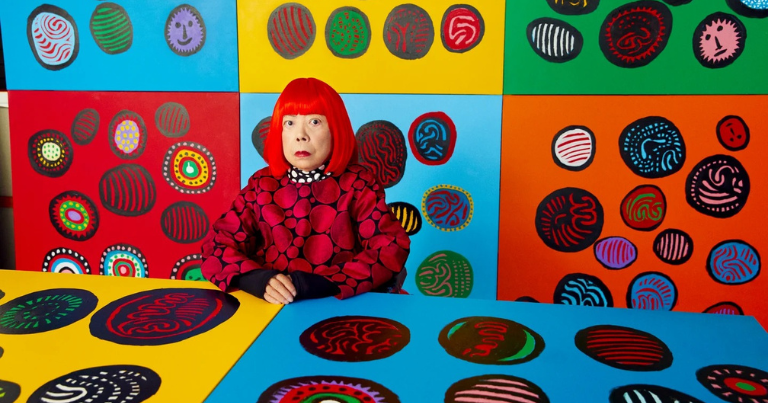
If you ever stood in line for one of Yayoi Kusama’s mirror rooms, and millions of people did, in Tokyo and London and New York and a dozen cities in between, you know the odd little ceremony of it. You wait a long time for something that lasts less than a minute. A door opens, you step inside, and for thirty seconds you are alone in what looks like infinity: lights repeating in every direction, your own reflection dissolving into a field of glowing dots that seems to go on forever. Then the door opens again, and you step back out into the ordinary afternoon, slightly changed, not quite able to say why.
Kusama, who died this month in a Tokyo hospital at 97, spent almost her entire life building rooms like that. Not just the literal ones, but paintings and sculptures and whole environments designed to hold you inside a feeling. What makes her worth remembering is not that she was famous, though by the end she was one of the most popular artists on earth. It is that she made the strangest, most private material imaginable, her own fear, into something a stranger could walk into and feel comforted by.
She had seen the dots since she was a child. They came with hallucinations that frightened her, patterns that multiplied across the walls and floor and threatened to swallow her whole. A lot of people handed that experience would have spent their lives running from it. Kusama did the opposite. She picked up a brush and started painting the dots herself, covering canvases and eventually entire rooms, and in doing so she took the thing that terrified her and made it hers. She called it self-obliteration, this dissolving of the line between a person and the endless world. In her hands it came out not as horror but as a kind of tenderness.
For a long stretch the art world didn’t quite know what to do with her. She arrived in New York in the late 1950s with almost nothing, a young Japanese woman in a scene that mostly took men seriously, and though she stood shoulder to shoulder with the era’s biggest names, the recognition kept landing on other people. She was ahead of them, and being ahead is often lonely. In 1973 she went home to Japan, and a few years later she checked herself, by choice, into the psychiatric hospital where she would live for the rest of her life, keeping a studio close by and working nearly every single day. That detail undoes people, but it shouldn’t be read as an ending. It was the arrangement that let her keep making things. She built a life that could hold both her illness and her art, and refused to let either one cancel out the other.
And what she made kept finding its way to people. The pumpkins, those cheerful, lopsided, yellow-and-black gourds she loved for being humble and unpretentious, became objects that fans crossed oceans to photograph. The dots turned up on everything, on towers and dresses and, eventually, on more phone screens than anyone could count. Right now a huge survey of her work is moving across Europe, through Basel and Cologne and Amsterdam, pulling crowds at every stop, more than three hundred works spanning seven decades. She was making new pieces almost to the end.
You could talk about her influence in the proper art-historical way. How she pushed installation and immersive work into the mainstream long before anyone was selling tickets to “experiences,” how she widened what a painting was allowed to be, how she opened doors for women and for artists who live with mental illness instead of hiding it. All of that is true and all of it matters. But it slightly misses the thing people actually felt in front of her work, which was simpler and harder to earn. She made avant-garde art that did not require you to understand it. Children loved her rooms. So did critics. So did people who had never set foot in a gallery before and would never go to another one. She built a doorway that almost anyone could walk through.
That, in the end, is the gift she leaves. She was frightened, by her own account, all the time, of everything. She said as much, plainly, even as she called herself a revolutionary in the same breath. She was underestimated for decades. She lived apart from the world in ways most of us never will. And out of all of it she made these glowing, dotted, infinite spaces whose whole purpose was to let a stranger stand inside for a moment and feel less alone in the enormity of things.
The rooms are still there. The line will keep forming. And for thirty seconds at a time, people who never met her will keep stepping into the world exactly as she saw it: endless, overwhelming, and, somehow, kind.