Web design has spent years learning how to add things. Bigger images, richer animation, custom fonts, autoplaying video, elaborate transitions and increasingly complex interactions have all become easier to build. The result is often visually impressive. It is also heavier than most users ever realize.
That weight has an environmental cost. Every time a website loads, data moves between servers, networks and devices, all of which consume energy. A single image or animation may seem insignificant, but multiplied across thousands or millions of page views, small design decisions begin to look much larger.
Brand studio MEK confronted that problem after discovering its own website produced more carbon than 76.5% of pages tested by the Website Carbon Calculator. At roughly 10,000 monthly page views, the studio estimated that the site was responsible for around 145.6 kilograms of CO₂ each year.
For a studio working with environmental and technology brands, the contradiction was difficult to ignore. MEK decided to rebuild its website with one unusual creative brief: every element would have to justify the energy it consumed.
The old homepage contained seven full-screen images, video and animations, with some files averaging around 8 MB. Images averaged roughly 700 KB. During the redesign, the team began questioning each component individually. Did it need to be there? Did it need to move? Did it need to be that large? Was it actually contributing anything useful?
The redesign replaced high-resolution JPGs with compressed and resized AVIF files, removed almost all video and motion, simplified navigation and reduced the amount of content on each page. The thinking was less about stripping the site to its bare minimum and more about eliminating elements that existed simply because digital design made them easy to add.
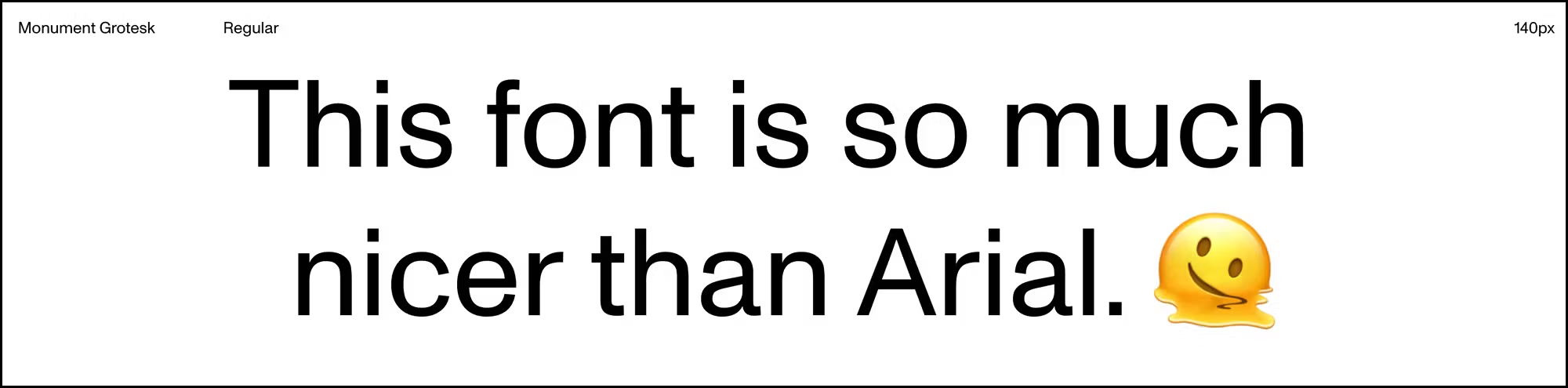
Typography revealed where that philosophy became more complicated. MEK initially replaced its custom Monument Grotesk typeface with Arial, a system font that requires no additional download and therefore reduces data transfer. The solution was efficient, but it also weakened the character of the brand.
The studio eventually settled on Google Fonts, accepting a small increase in energy consumption in exchange for a stronger visual identity and better user experience. That compromise captures an important point about low-carbon design. Sustainability does not require optimizing every page until personality disappears. It requires understanding the consequences of each choice and deciding which ones are worth paying for.
Colour became another part of the equation. MEK moved from a predominantly white interface to dark mode, which can reduce power consumption on OLED displays while also changing the visual character of the site. Again, the environmental consideration became part of the design brief rather than something added after the creative work was finished.
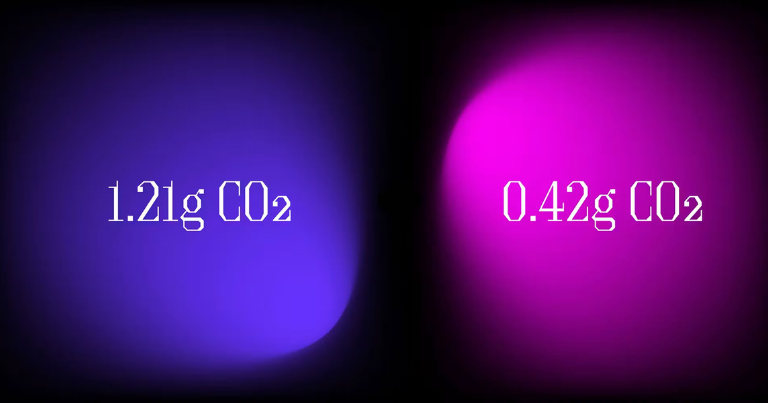
When the redesigned site was tested again, estimated emissions fell from 1.21 grams of CO₂ per page view to 0.42 grams, a reduction of around 67%.
The number is significant, but the process raises a broader question for digital design. Websites are routinely judged by speed, usability, accessibility, conversion and visual impact. Their energy consumption is rarely considered with the same seriousness, even though many of the decisions affecting emissions are made directly by designers.
An autoplaying video is a creative choice. So is a 4 MB image, a custom font family or an animation triggered every time someone scrolls. Their environmental impact may be invisible to the visitor, but invisibility does not make it irrelevant.
There is also a creative argument for restraint. When designers cannot solve every problem by adding another visual effect, they have to decide what the page is actually trying to communicate. Limits can force hierarchy, stronger typography, clearer messaging and more purposeful interaction.
That idea runs against a common assumption that sustainability requires sacrifice. In practice, lighter websites can also be faster, easier to navigate and less distracting. Reducing unnecessary data can improve the experience while lowering its environmental cost.
The future of sustainable web design may therefore depend less on a new technology than on an old creative skill: knowing when something is finished. Digital tools have made it remarkably easy to add one more thing. The more valuable decision may increasingly be knowing when not to.