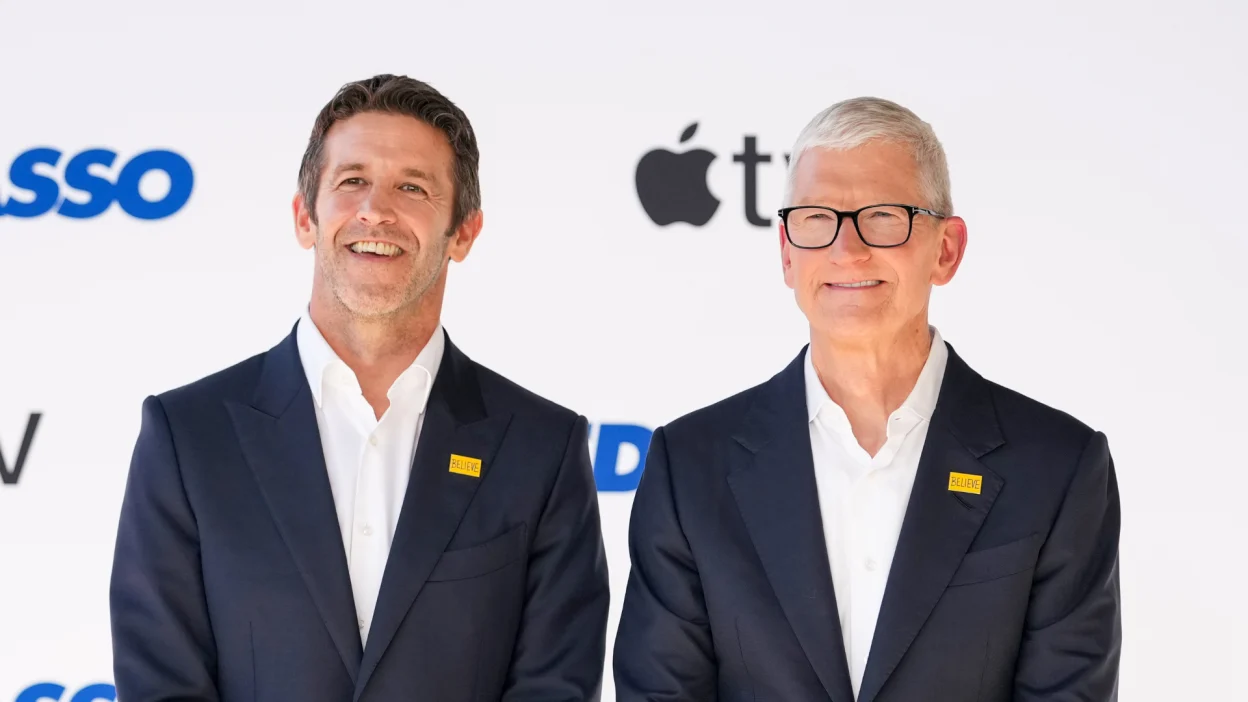
Tim Cook’s last earnings call as Apple’s chief executive delivered the best quarter of his fifteen years in the job. Revenue hit $109.4 billion for the June quarter, up 16 percent year over year and a June-quarter record, with double-digit growth in iPhone, Mac and Services and records across every geography Apple operates in. It’s also the quarter in which Cook told investors, bluntly, that the next one will be harder. John Ternus, Apple’s incoming CEO, inherits a business at its strongest point on paper and its most constrained on supply.
What happened
iPhone revenue reached $54.3 billion, up 22 percent, and Mac revenue rose 29 percent to $10.4 billion, both June-quarter records. Services revenue hit $30.7 billion, up 12 percent, with all-time highs in cloud and payment services and paid subscriptions surpassing 1.5 billion for the first time. Apple’s active installed base crossed 2.5 billion devices. Earnings per share came in at $2.02, up 29 percent, helped by roughly $2 to $3 billion in tariff refunds the company has pledged to reinvest in US manufacturing, including a new multi-year Broadcom agreement worth more than $30 billion.
Then came the warning. Cook described the current memory pricing environment as a “100-year flood,” driven by exponential DRAM cost increases that forced Apple into price hikes on iPad and Mac it says it didn’t want to make. CFO Kevan Parekh said memory costs alone explain more than the entire sequential decline in gross margin, from 49.3 percent in March to 48.1 percent in June, with a further drop to roughly 46.5 percent guided for September. Apple’s forecast for the current quarter puts revenue growth at just 9 to 11 percent, down sharply from the 16 percent just delivered, citing worsening supply constraints across iPhone, iPad and Mac alongside a foreign exchange headwind.
It was also, formally, the changing of the guard. Ternus, Apple’s senior vice president of hardware engineering since 2021 and a 25-year Apple veteran, sat in on the call and will lead future ones. He becomes CEO on September 1, with Cook moving into the role of executive chairman.
Why it matters
Handing over a company at a record high is the best-case version of a CEO transition, and Apple’s board built the process to look exactly that clean: an April announcement, a slow four-month handover, and a final earnings call timed to close on the strongest quarter of Cook’s tenure. That’s a deliberate contrast to the supply and cost picture Cook handed Ternus in the same breath. The memory shortage isn’t a one-quarter blip. It’s being driven by AI data centers, which are consuming roughly 70 percent of global memory chip production this year, while TSMC’s advanced-node capacity is already sold out through 2027. Ternus starts the job managing a structural squeeze on the component Apple’s entire hardware business runs on, with the DRAM market currently down to three major suppliers.
That timing shapes how Ternus’s first real test will be read. His background is product execution, not the AI or supply-chain diplomacy this specific moment demands, and investors will now attribute future hardware wins or delays to him personally in a way they didn’t when he answered to Cook.
The bigger picture
The market’s reaction told its own story. Days before the earnings call, optimism around the transition had briefly pushed Apple’s valuation above $5 trillion, overtaking Nvidia as the world’s most valuable company. The September guidance reset that math: Apple shares fell roughly 6.6 percent after hours despite beating Wall Street’s estimates on both revenue and earnings, and the company slipped back below Nvidia’s valuation. Investors, in other words, priced in the record quarter and the caution about the next one differently, rewarding the numbers Cook delivered while discounting the ones Ternus will have to manage.
That’s the paradox sitting underneath Apple’s succession. Cook leaves having overseen the company’s growth from roughly $150 billion in market value to a business capable of briefly touching $5 trillion, but he’s also leaving at the exact moment AI-driven demand for memory and advanced chips is squeezing the supply chain that made that growth possible.
What’s next
Ternus’s first earnings call as CEO comes in late October, covering the fiscal fourth quarter ending September 30, and it will be the first real test of how he handles the tension Cook flagged: pricing philosophy under sustained memory inflation, supplier diversification, and how much of the current guidance deceleration is temporary versus the opening chapter of a longer, industry-wide shortage that SK Hynix has forecast could worsen into 2027. Analysts will also be watching the timing and reception of the delayed Siri AI rollout, still held up by regulatory review in the EU and China, as an early signal of how Ternus intends to compete on AI once he’s setting strategy rather than executing someone else’s.