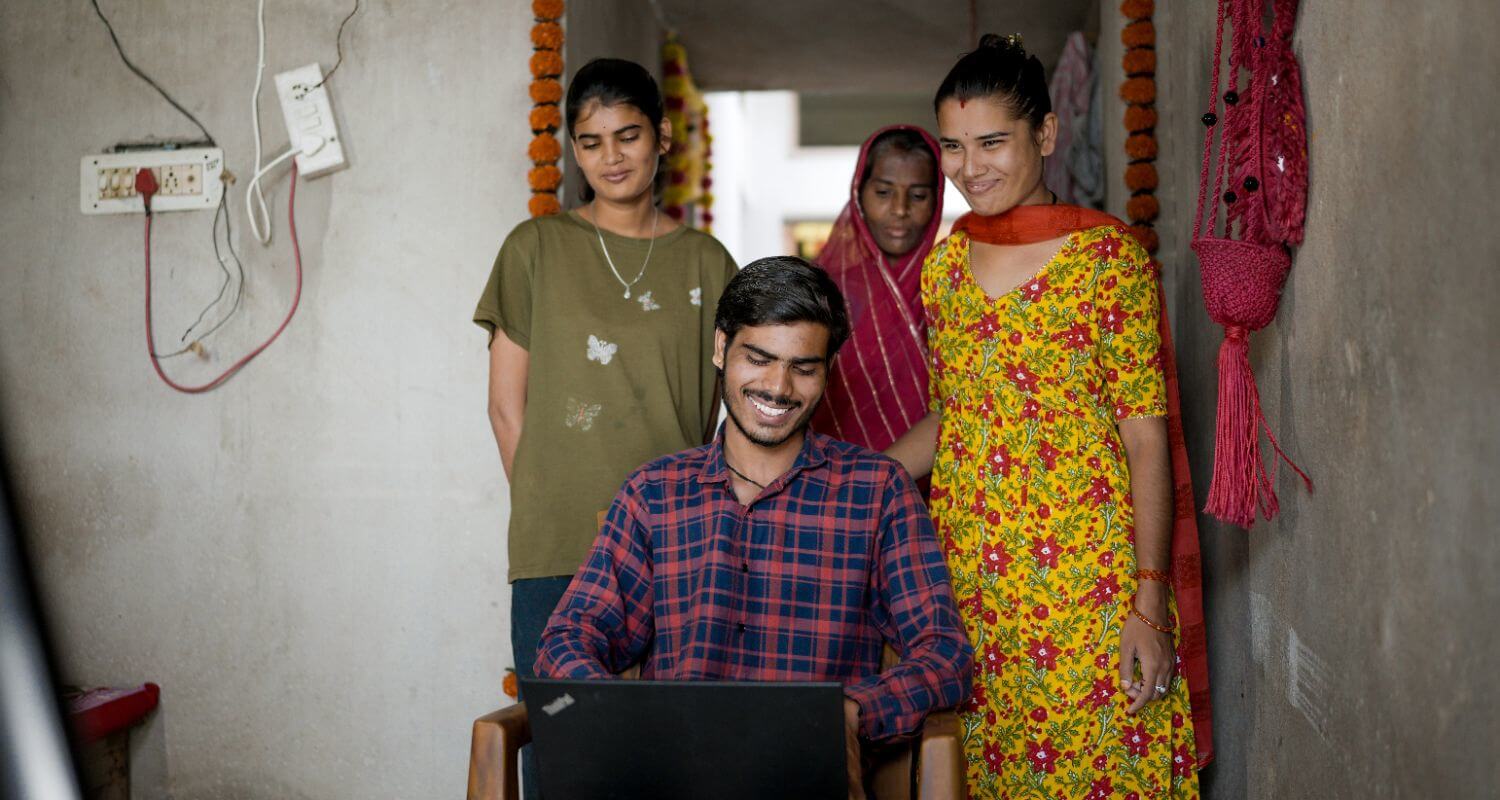
One billion students worldwide cannot afford internet access, and more than half of them are girls. George, founder of the US-based charity GiveInternet.Org, has spent the last several years trying to close that gap, one laptop and one home internet connection at a time.
“Give Internet is supporting determined students who live in refugee camps, conflict-affected areas, and low-income communities with free home internet, laptops, and professional training, so they can learn, create, and access opportunities and jobs, and build lives beyond the limits of where they are born,” George says. It is, he admits, the shortest version of the pitch he has. The longer one starts with a comparison he returns to often: in today’s world, internet access is close to as vital as water. Without it, people cannot learn, cannot access healthcare information, and are cut off from the economy and civic life. Worldwide, around 40 percent of the population cannot afford internet access. Infrastructure remains a real obstacle in many places, George says, but affordability is the bigger one.
The organization did not start with a global mandate. It began in Georgia, where George’s team was translating Khan Academy into Georgian, since almost no educational content existed in the language at the time. That work took them into more than 700 schools, teaching students and teachers how to use the platform. What they found in the classrooms changed the direction of the organization: about 20 percent of students who needed those resources most could not get them, because their families could not afford a laptop or a monthly internet bill.
From there, the problem turned out to be far bigger than one country. George points out that even in the United States, around three million students lack internet access for the same reason, affordability rather than availability. Give Internet now operates through partnerships with educational organizations rather than building programs from scratch. Its partners include the Harvard Humanitarian Initiative, MIT’s Emerging Talent program for refugees, and a University of Geneva community healthcare program running inside the Kakuma refugee camp in Kenya. Give Internet supplies the connectivity and hardware that let students in those programs actually take part, and, just as important, keep using their new skills after graduation.
Scaling the operational side has not been the hard part, George says, because demand from partner organizations is high and steady. Fundraising is harder. Give Internet is a registered 501(c)(3) charity, but it is still young, and building trust with donors takes time. “It requires time, lots of energy and commitment,” he says, describing the slower work of growing a base of individual donors rather than relying on a handful of large funders.
Artificial intelligence has added new urgency to the mission. George argues that AI tools widen the exact gap Give Internet is trying to close. Someone with internet access today can use AI to multiply their own productivity, in some fields several times over. Someone without it sees no change at all. “So even having access to internet means that they would also have access to AI tools,” he says, and a higher probability of using them to grow and realize their own potential. Introducing AI into a world with unequal access, he says, does not level anything. It widens the distance between the two groups.
Give Internet’s work extends past hardware and connections. Its partners run the professional training, but Give Internet runs what it calls a lifelong mentorship program, keeping every student connected through whatever channel is common in their country, WhatsApp, Facebook, or another platform, to pass along educational and job opportunities. The next step, George says, is helping graduates find work directly. The organization also runs a program called Mindful Internet, teaching students how algorithms are designed to influence them, how to tell manipulated or fake content from real, and how to protect themselves from propaganda and polarization online.
Roughly 78 to 79 percent of students earn money within 12 months of joining a program. About 40 percent share their devices and internet access with friends or family, so the benefit spreads past the individual student. And a number of graduates have started passing on what they learned. One student who went through the University of Geneva’s community healthcare program in Kakuma is now working to educate people in his own community about sexual health and disease prevention, an issue George describes as significant in refugee camp settings.
Give Internet has also started a program in Afghanistan, where women have been excluded from high school under Taliban rule. Through laptops and internet access, women there can study skills and find remote work outside a formal education system that no longer admits them.
Asked what he wants people to understand about the organization, George keeps returning to the same idea: access is not a convenience, it is the entry point to everything else, education, healthcare information, income, and now, increasingly, the tools of artificial intelligence itself. The bet behind Give Internet is that closing that entry point, student by student and community by community, is one of the more direct ways to keep the AI era from leaving half the world’s young people further behind than it already has.