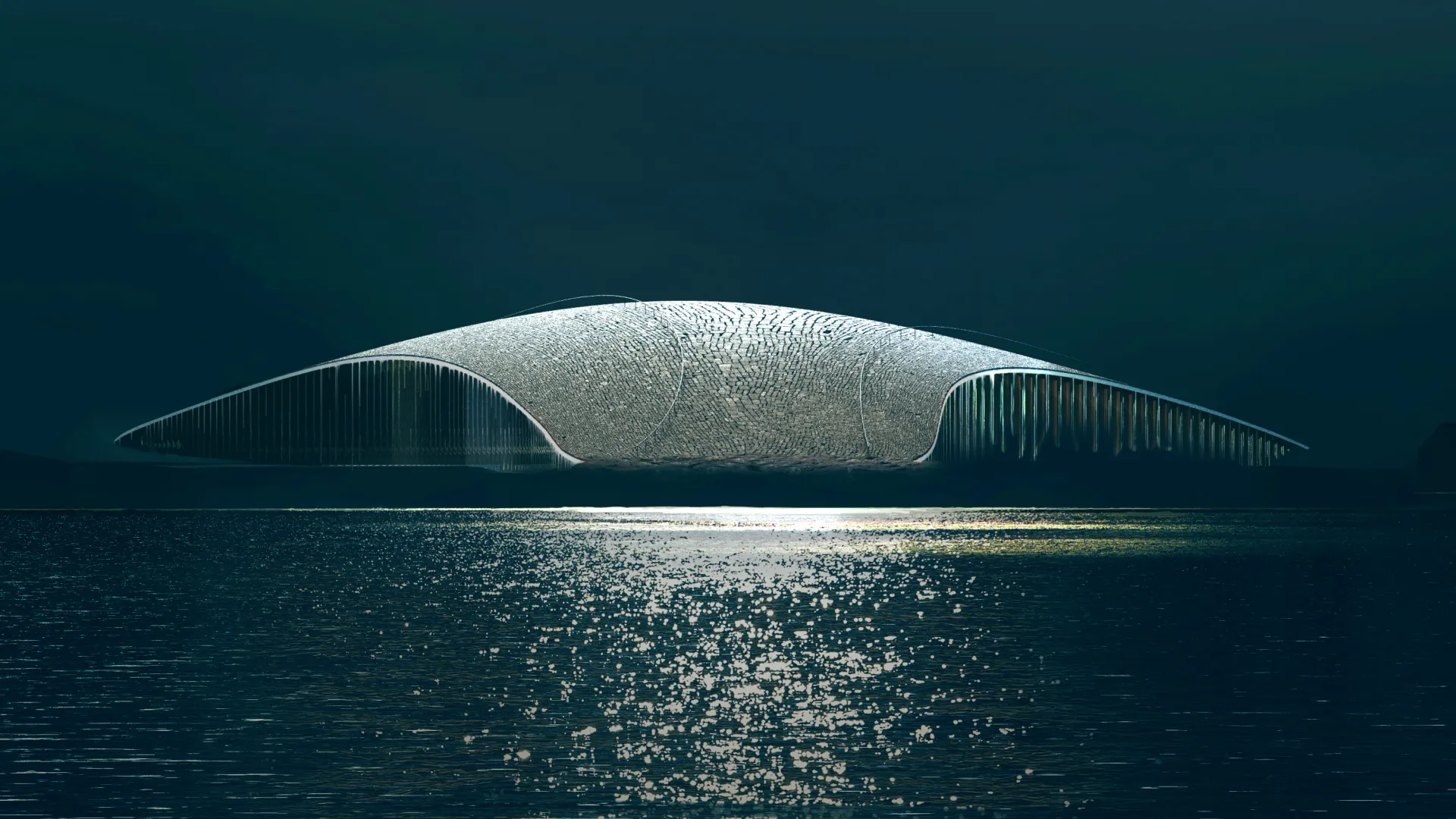
A new museum on the northern tip of Andoya island will open on June 4, 2027, giving visitors a way to experience whales without stepping on a boat. Called The Whale, the building sits in Andenes, roughly 190 miles above the Arctic Circle, and was designed by Copenhagen studio Dorte Mandrup A/S after winning a design competition in 2019.
The structure itself is the first exhibit. A single curved concrete shell rests on just three points of contact with the ground, leaving a column-free interior beneath it. The roof is covered in unworked stone gathered from the surrounding coastline and doubles as a public viewing platform, while a curved glass facade opens the building toward the archipelago. Architect Dorte Mandrup-Poulsen has described the approach as a question about horizon rather than boundary, which is why the design echoes the land’s curves instead of standing apart from them.
Inside, the museum covers five life-size wooden orca sculptures representing whales known to swim in Norwegian waters, a suspended whale model built around sound and movement, and a gallery tracing 90 living whale species across 50 million years of evolution. An anatomical section shows real bones and baleen, and a soundscape installation pairs whale calls and ocean audio with lighting design. Separate galleries address the history of whaling and the overlap between whale habitats and human activity, including shipping and fishing.
The project matters beyond its footprint. Andenes has run whale-watching tours since 1988 and now draws about 50,000 visitors a year, a number the region is counting on The Whale to grow once tickets go on sale in fall 2026. For a town this size, a museum built to this level of architectural ambition functions as infrastructure as much as culture: it gives Andenes a reason to appear on itineraries year-round, not just during whale season.
It also reflects a wider pattern in how remote destinations are competing for visibility. Museums built by name architects in unlikely locations, from Greenland’s Ilulissat Icefjord Centre to Norway’s own network of scenic-route rest stops, have become a deliberate tool for regions with strong landscapes but weak brand recognition. The Whale extends that strategy into marine tourism.