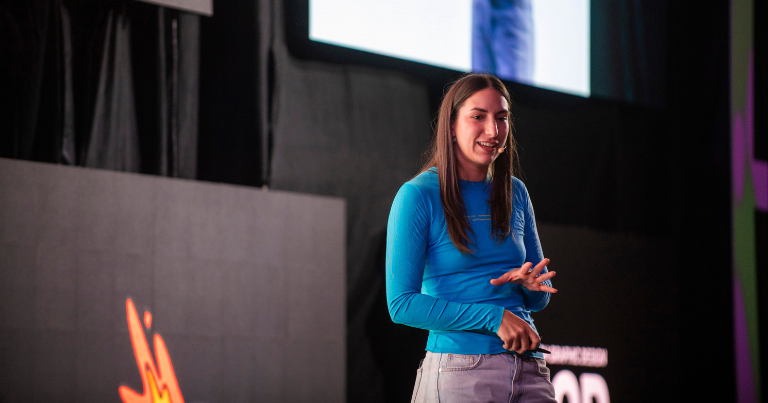
Creative industries are built around expertise. Johanna Jaskowska has spent much of her career trying not to become too comfortable with it.
At Ad Black Sea 2026, which has already wrapped up in Batumi, one of the most striking ideas came from artist and creative technologist Johanna Jaskowska. “I don’t want to be an expert on anything,” she said during her talk. In an industry where people are constantly encouraged to master a platform, build a recognizable style and become known for one thing, the line sounded almost deliberately wrong. Looking at Jaskowska’s career, however, it starts to make sense.
Her work has moved through experimental web design, augmented reality, generative AI and live visual direction, often at moments when those technologies were still unfamiliar and their creative rules had not yet been established. Jaskowska seems most interested in tools before everyone agrees on the correct way to use them. For her, being “on the edge” has less to do with chasing risk for its own sake and more to do with staying close to whatever still feels strange, unfinished or slightly confusing.
That instinct goes back to the internet she encountered in the 1990s. Jaskowska remembers early websites as chaotic, awkward and visually inconsistent, “very ugly but beautiful at the same time.” Growing up in Paris in a Polish immigrant family without much money, she learned early that the web could provide access to things that might otherwise have been out of reach. If she wanted to play a game, learn Photoshop or find anime, there was usually a forum, tutorial or workaround somewhere online.
The experience gave her what she now calls a “hacker mindset.” Technology was not something to use exactly as intended. It could be opened, tested, broken and recombined. That way of thinking eventually became central to her creative process and also explains why she is suspicious of expertise. Once you know a tool too well, she argues, it becomes harder to see what else it could do.
Jaskowska prefers the earlier stage, when she can still approach a technology with what she calls “a fresh eye” and start “connecting things that aren’t supposed to be connected.” In a creative industry currently absorbing new AI tools at extraordinary speed, that ability may be increasingly valuable. Mastering a platform can make someone faster, but being unfamiliar with it can sometimes make them more inventive.
Her own career offers a good example. After moving from Paris to Berlin in her early twenties, Jaskowska began experimenting with Unity 3D while mainstream web design was becoming cleaner, faster and increasingly standardized. Instead of following those conventions, she created a portfolio that behaved more like a video game. It loaded badly, struggled on mobile and ignored many of the emerging rules of good digital design. It also attracted attention.
The portfolio circulated through design communities, received recognition and eventually helped her land an agency job working with Mercedes-Benz. Jaskowska remembers the criticism with little concern. “Do you like it? Do you not like it? It’s good. It’s bad. Whatever,” she recalled. What mattered was that the work had created a reaction. Following every rule perfectly would probably have produced something more functional. It might also have produced something easier to forget.
The same curiosity later pulled her toward augmented reality. While working on Mercedes-Benz’s Play by Your Rulescampaign, she started experimenting with face filters at a time when the format was still largely associated with novelty effects. AR would eventually become one of the defining mediums of her career, giving her a recognizable visual language built around transformed faces, metallic skin and digital bodies.
That chapter ended in a way Jaskowska could not control. When Meta discontinued its third-party AR platform, years of work suddenly became inaccessible. During her Ad Black Sea talk, she showed a video recorded on the final day her filters were still available, as she tried to archive them before they disappeared. “Look at my face. I’m super sad, like, no spark, just archiving everything,” she said.
She described the experience as grief. Years of experiments, projects and digital objects had effectively been switched off by the company that controlled the platform. Yet Jaskowska also recognizes that losing AR forced her to move somewhere else. “It was also the thing I needed to do what I’m doing today,” she said. In a career built around emerging technologies, even success has an expiration date.
What came next was generative AI. Jaskowska approached it much as she had once approached AR, using the medium to return to long-standing interests in altered bodies, metallic textures and speculative relationships between humans and technology. The difference was that AI could now produce levels of visual detail and transformation that would have been far more difficult to achieve with her earlier tools.
Her process is also more complicated than the popular idea of AI image-making suggests. Jaskowska combines trained models with photography, Photoshop, painting, selective generation and repeated editing. Images pass through several stages before they reach their final form. “AI work is like a lot of Photoshop,” she said. “It’s not like prompting an algorithm.” For her, the technology is less an automatic image machine than another material to manipulate.
Those experiments have since grown into editorial commissions, her Madrid-based creative studio and large-scale visual work for techno artist Charlotte de Witte. What began as exploration without an obvious commercial purpose eventually became useful in ways she could not have predicted at the beginning.
That was perhaps the strongest connection between Jaskowska’s story and this year’s Ad Black Sea theme, On the Edge. Creativity, in her version of it, is not about permanently occupying some radical position. It is about recognizing when the thing that once felt experimental has become familiar and being willing to move again.
Toward the end of the talk, she addressed a question she apparently hears often: what comes next? Her answer was simple: “I don’t know. I never know.” Coming from someone whose career has moved across technologies that appeared, exploded in popularity and sometimes disappeared entirely, uncertainty no longer sounds like a lack of direction.
It sounds like a method.
Jaskowska’s career suggests that creative longevity may depend less on protecting one successful identity and more on knowing when to abandon it. The common thread in her work has never really been web design, AR or AI. It has been the willingness to become inexperienced again.