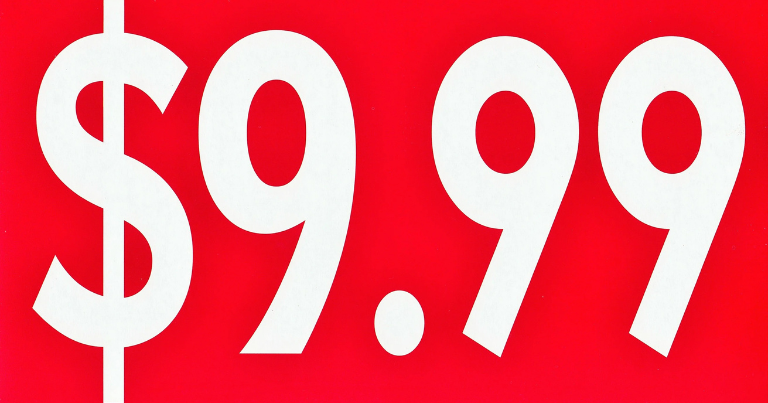
Walk through almost any supermarket, browse an online store or open a food delivery app and the same number keeps appearing. $9.99. $19.99. $49.99. A product can cost one cent less than the next round number, an amount so insignificant that few shoppers would bother picking it up from the pavement, yet retailers have spent more than a century treating that cent as if it matters.
At first glance, the logic seems almost embarrassingly obvious. $9.99 is technically cheaper than $10, so perhaps it simply looks cheaper too. But the endurance of 9-ending prices is more interesting than a one-cent discount. They have survived supermarkets, department stores, credit cards, ecommerce, mobile shopping and increasingly cashless economies. Consumers know exactly what retailers are doing, and retailers know consumers know. Still, the nine remains.
The practice is old. Research on 9-ending prices traces their widespread commercial use back to at least the late nineteenth century, long before digital analytics could measure whether changing $10 to $9.99 improved conversion rates. Today, the strategy appears across countries and product categories so routinely that the unusual price is often the round one.
The obvious question, then, is why a trick that everyone can see still appears to work.
Your Brain Does Not Always Read $9.99 as “Basically $10”
One of the most influential explanations is known as the left-digit effect. When people process prices quickly, the digits on the left can disproportionately influence how large a number feels. The crucial difference between $9.99 and $10.00 may therefore be less about the missing cent than about crossing from a price beginning with 9 to one beginning with 10.
Researchers Manoj Thomas and Vicki Morwitz explored this effect in a series of experiments published in the Journal of Consumer Research. They found that nine-ending prices were more likely to be perceived as meaningfully lower when the leftmost digit changed. In other words, the difference between $2.99 and $3.00 could feel larger than the mathematical difference of one cent would suggest because the first number begins with a two and the second with a three. The effect was also stronger when the prices being compared were already relatively close to one another.
That helps explain why $19.99 has such a peculiar advantage over $20.00. We may consciously understand that both represent roughly twenty dollars, but price perception does not always happen through careful arithmetic. Shopping often involves scanning shelves, comparing dozens of products or flicking rapidly through a list of options. Under those conditions, a price can be processed before it has been fully considered.
The left side gets there first.
This does not mean consumers literally believe $9.99 is nine dollars. The mechanism is subtler. The price can simply land slightly lower in our mental comparison than $10.00, and in a competitive retail environment, “slightly” can be commercially valuable.
Later research found that changing just-below prices to round prices can influence which product shoppers choose, particularly when they are deciding between lower- and higher-priced alternatives. A 2009 Journal of Consumer Researchstudy found that price endings could shift choice toward the cheaper option, although the result depended on factors including price level and the shopper’s goal.
The Nine Also Says “Deal”
There is another reason $9.99 survives: consumers have spent decades learning what a nine-ending price is supposed to mean.
Numbers acquire associations through repetition. A price ending in 9 has appeared so frequently in discount stores, supermarket promotions, clearance sections and direct-response advertising that it can communicate something beyond its numerical value. It can signal that the seller is competing on price.
That means $19.99 and $20 can carry slightly different personalities even though their economic difference is negligible. One may feel engineered to look affordable. The other can feel cleaner, calmer and less concerned with appearing cheap.
Researcher Robert Schindler, who has studied 9-ending prices extensively, notes that they can evoke ideas of bargains and discounts. That association can help explain why the strategy tends to fit certain purchasing environments better than others. A shopper hunting for a deal may interpret $49.99 as evidence of value, while the same visual language may be less useful for a brand trying to communicate rarity, prestige or simplicity.
Look at the pricing language of luxury and the contrast becomes obvious. High-end restaurants often prefer 40 to 39.99. Luxury fashion frequently presents prices without cents altogether. Premium services may choose round monthly fees because a price like $499.99 can make the company appear as though it is trying unusually hard to persuade you that $500 is inexpensive.
Numbers are part of brand language too.
Round Prices Have Their Own Psychology
If $9.99 were universally superior, every product would end in 9. They do not.
Research suggests that rounded prices can work differently because they are easier to process. Studies led by Monica Wadhwa and Kuangjie Zhang found that round prices can fit purchases driven more heavily by emotion, while non-rounded prices can encourage more analytical processing. When a purchase “feels right,” a clean number can reinforce that feeling.
Consider the difference between buying a bottle of detergent and booking a romantic weekend away. One decision may invite comparison, budgeting and calculation. The other may benefit from reducing the sense that a spreadsheet is involved at all.
There is also evidence that when consumers choose prices themselves, they show a preference for round numbers. Studies of pay-what-you-want transactions and self-service petrol purchases found that people disproportionately selected round totals. When shoppers control the number rather than marketers, they often seem to like numerical neatness.
This makes pricing more complicated than the familiar rule that “9 sells better.” Sometimes $100 feels stronger precisely because it does not look like $99.99. It can appear more confident, more premium or simply easier to understand.
The appropriate ending depends on what the price is supposed to communicate.
So Does $9.99 Actually Work?
This is where one of marketing’s most repeated pieces of advice becomes less satisfying.
The accumulated evidence does suggest an advantage for just-below pricing, but not the enormous psychological effect sometimes implied by popular explanations. A large preregistered meta-analysis published in the Journal of Consumer Psychology examined 69 studies, 362 effect sizes and more than 40,000 participants. It found that just-below prices such as $9.99 tended to improve price perceptions and slightly increase purchase decisions compared with round prices. They were also more likely to be underestimated.
The important word is “slightly.”
The researchers found considerable variation across studies, and corrections for publication bias suggested that some underlying effects may be smaller than they initially appear. A newer 2026 study comparing round, just-below and precise prices similarly noted that the broader research record remains mixed, with positive, negligible and occasionally reversed effects depending on context.
That nuance matters because psychological pricing is often described as though the human brain contains a permanent software bug: replace $10 with $9.99 and sales automatically rise. Real consumers are harder to manipulate so predictably.
Price endings interact with product type, shopping goal, competing options, brand positioning, purchase involvement and the size of the price itself. A cent can influence perception without overriding everything else a customer knows about the product.
Nobody buys a bad laptop because it costs $999.99 instead of $1,000.
But if two laptops already look similar, a small perceptual nudge may help one feel cheaper.
In retail, that can be enough.
Ecommerce Gave an Old Trick New Life
The strange thing about charm pricing is that modern commerce should theoretically have killed it.
Cash transactions once made cents physically visible. Today, many purchases happen with a tap, stored card or digital wallet. Nobody ordering a $9.99 subscription is likely to hand over a ten-dollar note and wait for a penny in change. The original physical significance of the final digit has largely disappeared.
Yet digital shopping may actually provide an ideal environment for the effect.
Online stores are built around comparison. Product grids can place $29.99 beside $34.99 beside $39.99, allowing shoppers to scan prices in fractions of a second. Search results can be sorted from low to high. Marketplaces show multiple sellers competing for the same click. Subscription pages often place three or four tiers side by side.
In those situations, the job of a price is not only to tell you how much something costs. It needs to survive comparison.
A retailer selling thousands of products also does not need $9.99 to transform every decision. If a tiny pricing adjustment improves conversion by even a fraction across a very large volume of transactions, the cumulative financial effect can become meaningful. The persistence of charm pricing therefore does not require consumers to be dramatically fooled. It only requires the strategy to perform slightly better often enough.
That is a much more believable explanation for its survival.
We Know the Trick, and That Barely Matters
Perhaps the strangest part of $9.99 is that there is no secret.
Consumers have encountered charm pricing for generations. Most people could explain the intended effect without having studied marketing. If asked whether $19.99 is basically $20, practically everyone would say yes.
But awareness and immunity are different things.
Much of consumer behaviour happens under conditions where nobody stops to carefully analyse a price. We shop while tired, distracted or rushed. We compare multiple options, respond to familiar signals and use shortcuts because calculating the objective value of every purchase would be exhausting.
Marketing often operates inside those shortcuts. A sale label can still attract attention even when you know retailers use sale labels to attract attention. A familiar brand can still feel safer even when you understand the role of familiarity. Packaging can influence expectation even when you know packaging is marketing.
The same applies to price endings. Understanding the mechanism does not necessarily remove every small perceptual effect it creates.
There is also an element of convention. Consumers expect certain kinds of products to have certain kinds of prices, while retailers have learned to operate inside that expectation. Once $9.99 becomes the normal visual language of mass-market retail, abandoning it can itself communicate something.
A supermarket price of $10.00 may feel strangely deliberate.
One Cent That Was Never Really About One Cent
The remarkable thing about $9.99 is not that shoppers fail to notice the missing cent. It is that pricing happens in perception as well as arithmetic.
A price tells us how much money to pay, but it can also suggest whether something is a bargain, premium, discounted, simple, luxurious or aggressively competitive. The final digits contribute to that impression long before a customer reaches the checkout.
That is why $9.99 has proved so difficult to kill. Its advantage may be small, inconsistent and heavily dependent on context, but businesses do not necessarily need a psychological technique to work dramatically. At scale, they need it to work a little.
More than a century after retailers began filling their signs with nines, the tactic is still sitting on supermarket shelves and ecommerce pages around the world. Everyone can see what it is doing.
Apparently, that has never been enough to make it disappear.