For decades, marketing has sold one reliable promise: more choice, more convenience and, eventually, a better life. That promise is getting harder to keep.
Consumers have more content than they can watch and more tools to optimise their lives than they can use, but they aren’t more satisfied. Attention is fragmented, social media is increasingly linked to harm, and the future feels less certain.
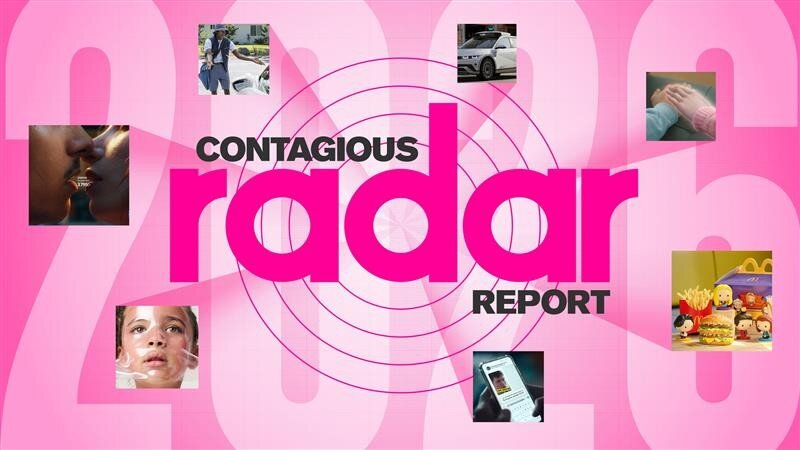
That tension runs through Contagious Radar 2026, the annual report on the cultural and technological shifts shaping marketing. Its six trends share one thread: people want more control, meaning, connection and security. That is a problem for an industry built on the belief that more is better and tomorrow will beat today.
The attention economy has reached saturation point
Contagious calls this The Attention Sink. Watching everything on Netflix would take around 16 years. YouTube receives roughly 30,000 hours of video every hour, and in 2025 Spotify removed 75 million AI-generated tracks.
The harder task for brands now is turning attention into memory, and short clips rarely build attachment to whoever made them. In the report’s survey, 89% of marketing and agency leaders said brands should do fewer, higher-quality things on social. Bilt’s largely unbranded vertical sitcom Roomies averages 1.2 million weekly viewers. The Financial Times’ For the Why campaign presents depth as the answer to information overload.
Nostalgia has become an industry
Streaming archives, generative AI and analogue hobbies keep the past permanently available. Adults account for 28% of global toy sales, Build-A-Bear’s adult share has doubled from 20% to 40%, and 37% of Gen Z feel nostalgic for a 1990s most barely remember. McDonald’s, Gap and sunscreen brand Vacation have all drawn on earlier eras. Contagious treats the archive as raw material. What people actually buy is the feeling attached to another era: familiarity, simplicity or optimism.
In the age of AI, getting people into the same room may become radical
Under The Loneliness Disconnect, the report shows how frictionless digital life reduces the need for other people, and then sells more technology to fill the gap. 28% of US adults say they have had an intimate or romantic relationship with AI. Mattel’s Uno Social Club, Heineken’s rooftops in Seoul and a free London venue from Palace and Nike point to what Contagious calls an “infrastructure of belonging”. While AI companies work to make machines feel more human, one distinctive thing a brand can offer is access to other people.
Social media is acquiring the language of vice
Age restrictions and concerns about addiction, mental health and privacy are pushing platforms toward regulation. Even so, WARC predicts social will take 28.4% of global ad spend in 2026, nearly double its 2020 share. Brand safety now covers the platform itself. Contagious expects marketers to spread spend across creators, podcasts and traditional media, and to weigh where they want the brand to be seen alongside how efficiently it reaches people.
Self-improvement has become an obligation
The Optimisation Obligation describes the body as one of the few things that still feels controllable. Pinterest searches for “rebranding yourself” rose 240% in 2025, and the beauty-tech market has reached $66.15 billion. Adding to that pressure may backfire. The Ordinary has built its reputation on clear pricing and plain ingredient lists, which reflects a broader move from self-improvement toward self-care.
What if consumers stop believing in a better future?
Aspirational marketing assumes people believe their lives are moving somewhere better. In the US, 49% of Gen Z say planning for the future feels pointless, and the median homebuyer age has risen from 31 in 1980 to 59. Globally, 66% of people say they live for today because the future is uncertain, and only 6% of Gen Z list senior leadership as a top career goal. In that climate, small pleasures and experiences make emotional sense. IKEA’s Wherever Life Goes and Asics’ focus on the mental side of movement both find value in the present. Contagious’ conclusion: when the future feels unpredictable, value has to become visible sooner.
Marketing has a “more” problem
Taken together, the trends describe people who have more content, connections and self-improvement tools but feel no more satisfied. Marketers feel this too. Contagious surveyed 100 C-suite leaders, and their top concerns for 2026 include economic uncertainty, the devaluing of creativity and an overcrowded content environment. Marketing has spent years adding things to people’s lives. In 2026, the brands that matter may be the ones that take away noise, pressure, friction, loneliness or uncertainty.
To read the full Contagious Radar Report 2026, visit the link and complete the required form.