Nicola Bertellotti once spent seven hours inside an abandoned church waiting for the right light. He is also willing to leave a place without taking a photograph, however extraordinary it might be. For more than fifteen years, he has photographed buildings caught between the loss of their original purpose and their eventual disappearance: villas, theatres, churches and factories whose interiors still carry evidence of the people who occupied them. His interest began with cinema and a childhood fascination with rusting amusement park rides. In this conversation, he discusses the temptation to make decay look beautiful, the stories he invents before learning a building’s history, and why a perfectly restored hotel can make him imagine thirty years of dust.
M: You’ve said that the subject made you a photographer. If every abandoned building you wanted to photograph were restored tomorrow, what would be left of your photography?
Probably the same obsession, but I would have to find another way of expressing it. Photography wasn’t really the starting point. Cinema was my first love. When I was very young, I made short films with friends and dreamed of becoming a director. Later, I studied History. Photography arrived almost accidentally, through travelling, and then I encountered these places and everything suddenly came together.
If I had known how to write well enough, perhaps I would have written about them. If I could paint, perhaps I would have painted them. I happened to have a camera. So if every abandoned building were restored tomorrow, I think what would remain is my fascination with time and with things that exist between two states.
I’ve always thought of my work as witnessing a very precise interval: between the moment a place loses its function and the moment it disappears altogether. Remove the ruins and I would probably start looking for that interval somewhere else. In the end, I am less interested in abandonment than in impermanence.
M: Has a place ever been too beautiful to photograph, so that taking a picture felt like reducing what you were experiencing?
Yes. And sometimes I don’t photograph it. There is a strange misunderstanding about photography: that if something is extraordinary, it necessarily produces an extraordinary photograph. Often the opposite is true. You enter somewhere and the experience is so physical, with the smell, the temperature, the silence, the scale and the light moving through the room, that putting a rectangle around it seems almost reductive.
I’ve waited seven hours inside an abandoned church for the light I wanted. At that point, you’re not really “taking pictures” anymore. You’re simply living with the place. And there are occasions when nothing happens. I leave without a photograph. Years ago, that would probably have irritated me. Now I think it is perfectly legitimate. Photography doesn’t have to possess everything. Some places can remain experiences.
M: What is the smallest human trace that can make an empty room feel inhabited again?
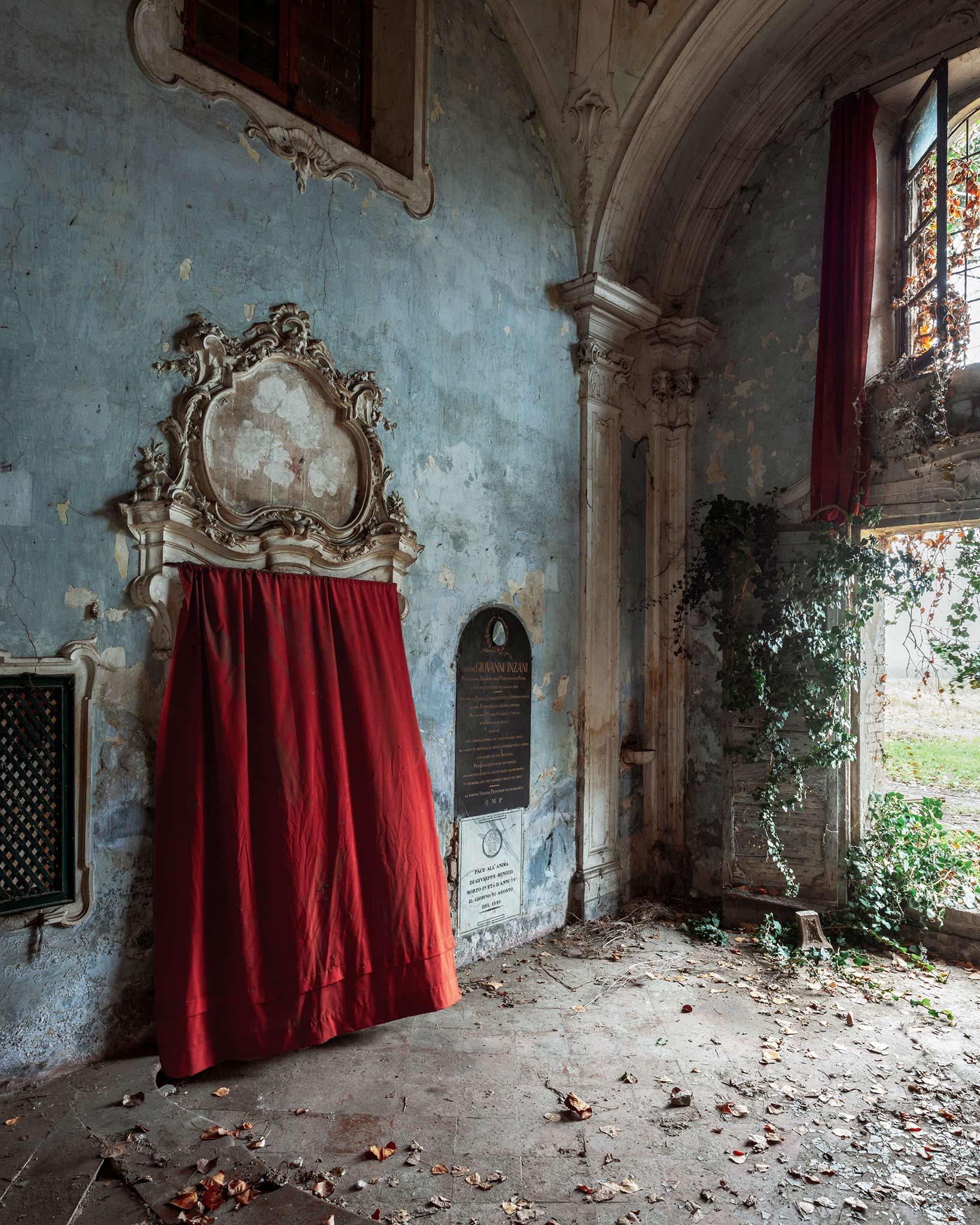
A letter on the floor. A family photograph. A chair slightly removed from a table. I’m fascinated by what we could call microhistory. You can enter the house of an important historical figure and find traces of History with a capital H, but sometimes an anonymous farmhouse containing a handwritten letter can affect me more.
These objects are like Proust’s madeleine. I’ve used that comparison before because it describes very precisely what happens to me in these places: an insignificant object suddenly opens an enormous space in memory. And it doesn’t even have to be my memory. That’s the strange part. Sometimes I feel nostalgia for something I never experienced. A chair pulled away from a table is enough. Someone is no longer there, but the gesture of getting up from the chair somehow remains.
M: When you enter a building without knowing who lived there, do you want to discover its history immediately, or do you prefer not knowing?
I definitely prefer not knowing at first. History is important to me, I studied it, after all, but imagination needs a little time before documentation arrives and corrects everything.
When I cross the threshold of an abandoned building, there is often this strange transfer: the place begins to resemble something that was already inside me. A book, a film, a childhood memory, sometimes something I can’t identify at all. So initially, I want to listen to the objects. A photograph on the floor, books on a shelf, the wallpaper someone chose fifty years ago, the difference between what was taken away and what was left behind. You begin constructing a completely imaginary biography.
Later, I want to know the truth. And often the truth destroys the story I’ve invented, which I enjoy enormously. Because then there are two buildings: the historical building and the one I imagined. The photograph lives somewhere between them.
M: Restoration can save a building while erasing the condition that drew you to it. When a place you’ve photographed is restored, do you feel relief, loss, or both?
Both, without question. Obviously, I want these buildings to survive. I’m interested in history, so wishing for their destruction simply because decay photographs well would be absurd.
But John Ruskin, the nineteenth-century British writer and art critic who wrote extensively about architecture and preservation, understood something fundamental: time is not simply something that damages a building. It also becomes part of it. Victor Hugo expressed a similar idea when he suggested that time gives architecture its final touch. So restoration creates a paradox for me. You save the building, but sometimes you erase part of its biography.
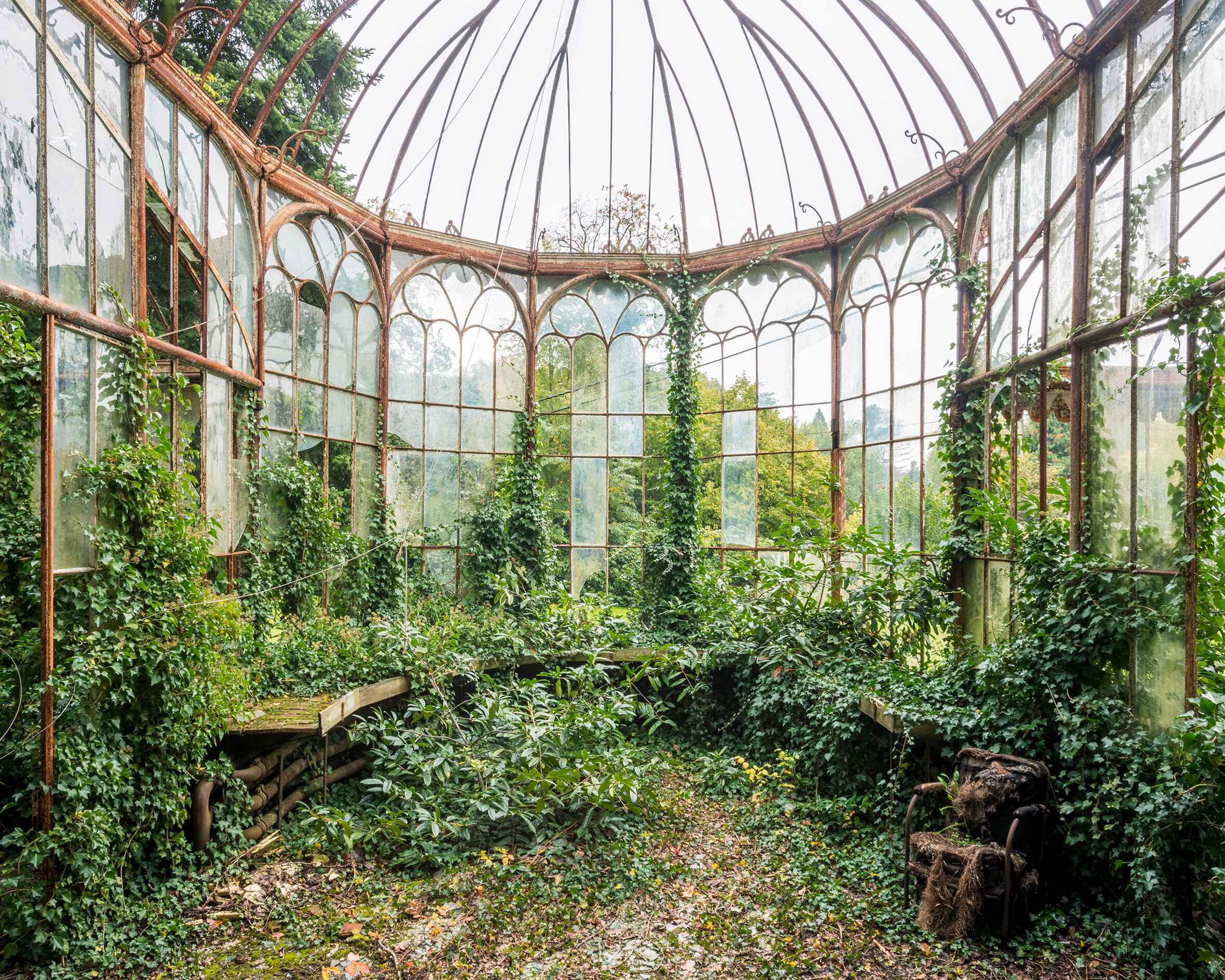
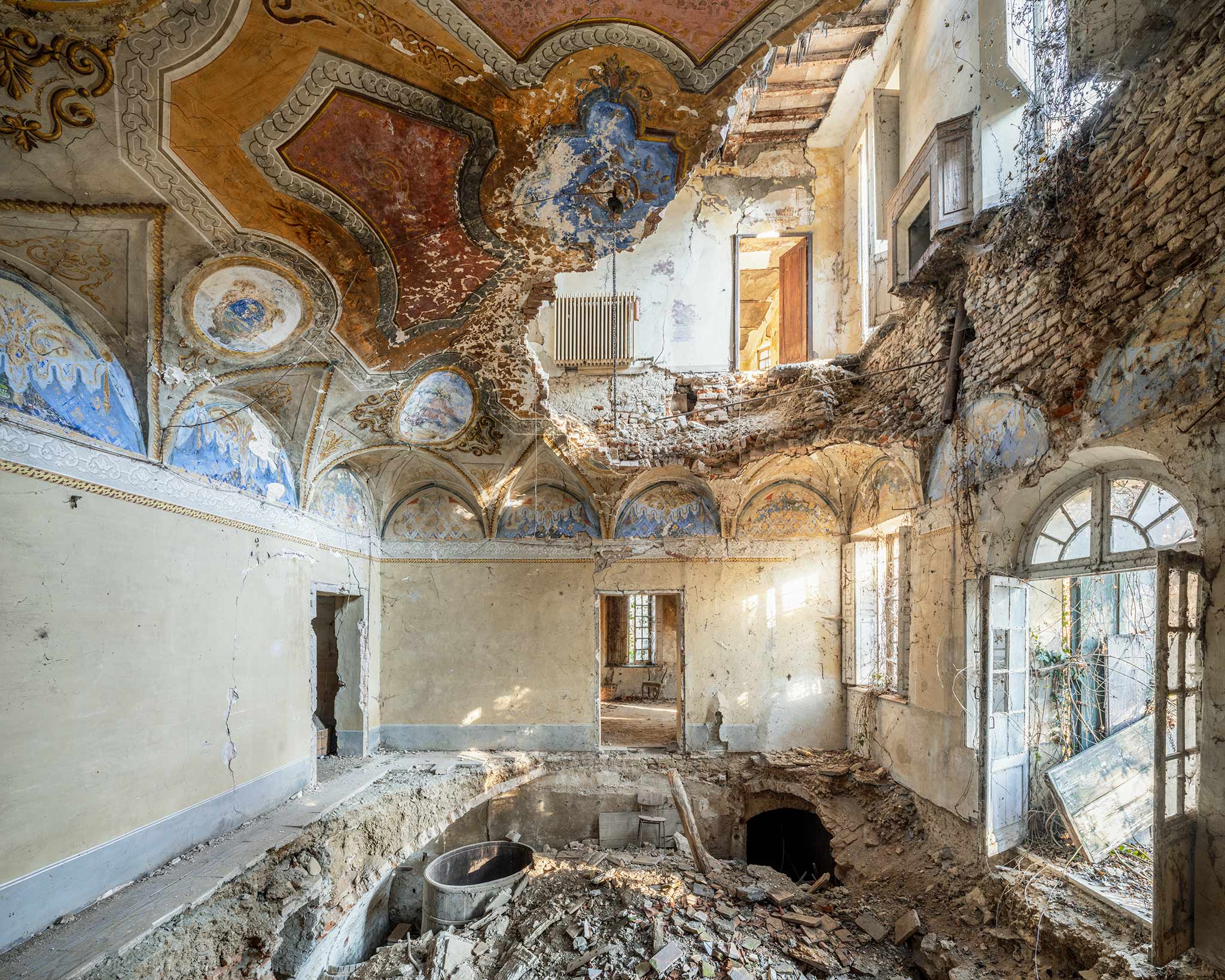
A cracked wall, five layers of wallpaper, a faded fresco, vegetation entering through a window: these are not simply defects. They are evidence. And many of the places I’ve photographed no longer exist. In that sense, photography has acquired a function I didn’t entirely anticipate when I started: it becomes testimony. I photographed one moment in the biography of a building, and sometimes that moment existed only briefly. I don’t want ruins to remain ruins for my benefit. But I do sometimes mourn the disappearance of their scars.
M: Your photographs are carefully composed, almost painterly, even when the subject is collapsing. How do you recognise when an image risks romanticising abandonment?
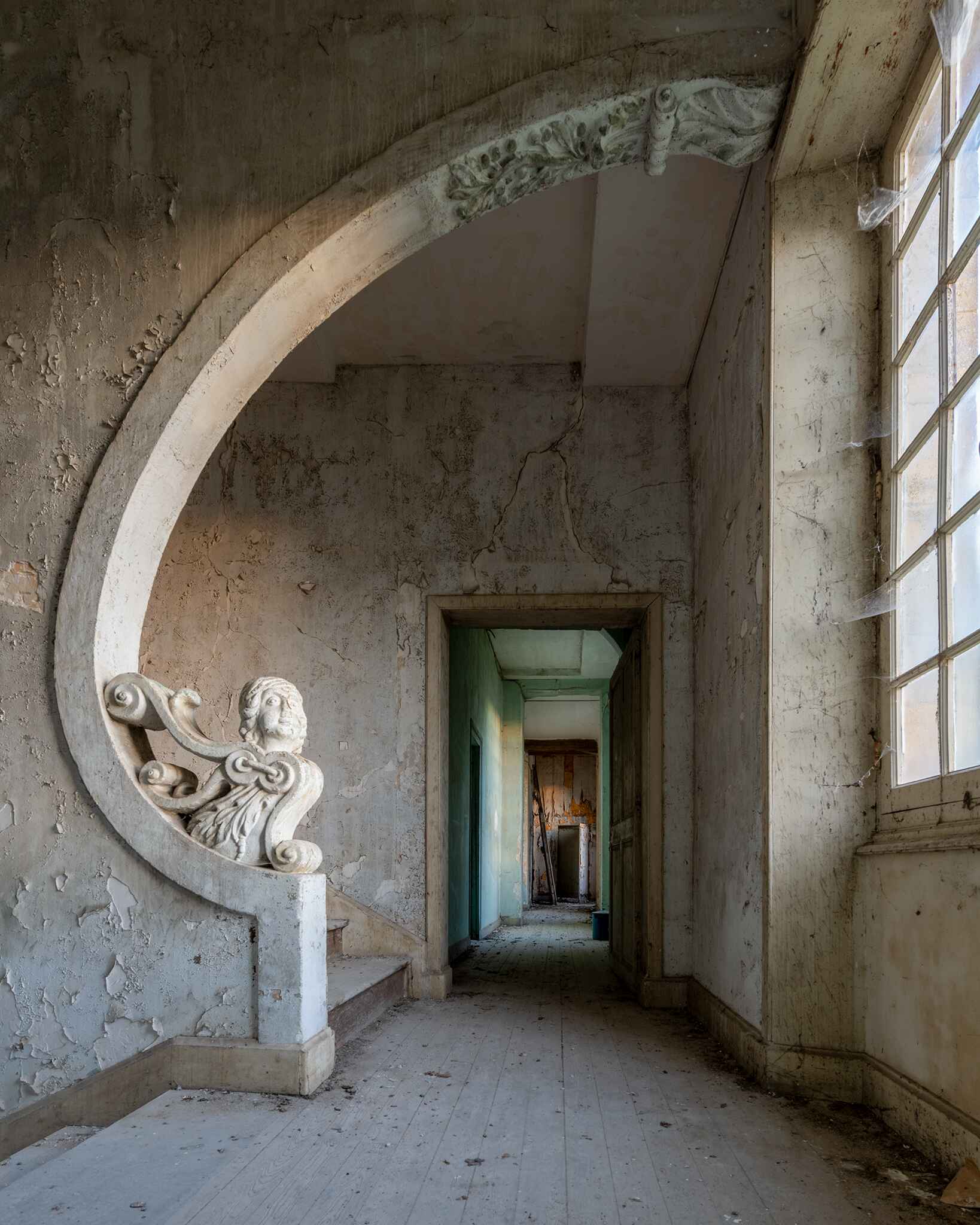
That’s probably the most dangerous temptation in this kind of photography. Decay is incredibly photogenic. Give me peeling wallpaper, a grand piano, vegetation coming through a window and beautiful afternoon light, and the photograph can almost make itself. That is precisely when I become suspicious.
I’ve never been interested in abandonment simply because it is abandoned. What interests me is what time has done to the place: the stratification, the transformation, the point at which something made by human beings begins to become something else.
There is a decadent element in my work, and I don’t deny it. À rebours is even the title of one of my photographs. I am interested in beauty precisely when it becomes fragile, excessive, imperfect. But beauty should be the entrance to the photograph, not its conclusion.
If someone looks at one of my pictures and says only, “What a beautiful ruin,” then perhaps the photograph hasn’t gone far enough. I would prefer that beauty creates a second question: why does the disappearance of something move us so much? Perhaps because the ruin resembles us more than we would like to admit.
M: After more than fifteen years of photographing things that are disappearing, do you see places that are still intact differently?
Yes. I don’t really believe in the word “intact” anymore. Studying History already teaches you that permanence is largely an illusion, but photographing these places makes that idea physical.
I’ve stood inside enormous factories, villas, theatres and institutions that were built as demonstrations of wealth, power or technological confidence. Nobody who built them imagined someone like me walking through them decades later in complete silence. So sometimes, when I enter a perfectly restored theatre or hotel, I unconsciously imagine its future ruin. I remove the people, turn off the lights, add thirty years of dust. It’s probably an occupational disease.
But I don’t find the thought depressing. Quite the opposite. Impermanence makes things more precious. Nicolas Bouvier, who has always been very important to me, wrote about travelling as something that strips you down rather than decorating you with exotic experiences. I think ruins have done something similar to my way of looking. They have removed the illusion of permanence.
M: Your titles often draw on literature and cinema. Has a title ever changed your understanding of a photograph after you had taken it?
Absolutely. For me, the title is part of the photograph. When I enter these places, I often experience a strange familiarity. I have the sensation that I’ve already encountered what I’m seeing somewhere: in a film, in a novel, in something I read twenty years ago and perhaps don’t even consciously remember.
The place seems to provide an image for something that previously existed only in my imagination. That’s probably where cinema enters my photography most strongly. Cinema was there before photography for me. So although the final image is still, mentally I often approach a room almost as if it were a scene.
Then the title arrives and creates the missing connection. Some are literary, some cinematic, some mythological. À rebours, Melancholia, The Great Beauty, Infinite Jest, L’ora che volge il disio… They’re not captions. I don’t want them to explain what the viewer is seeing. They’re more like another door into the image. Sometimes I find the title months or even years later, and suddenly the photograph becomes complete. The image hasn’t changed, but its gravitational field has.
M: Images of abandoned buildings are everywhere online. Has social media made us better at seeing decay, or simply better at consuming it?
Probably much better at consuming it. When I started, finding these places required an almost obsessive kind of research. I still spend nights looking at satellite maps, archives, obscure videos. It feels like a treasure hunt: eventually, you find the X on the map.
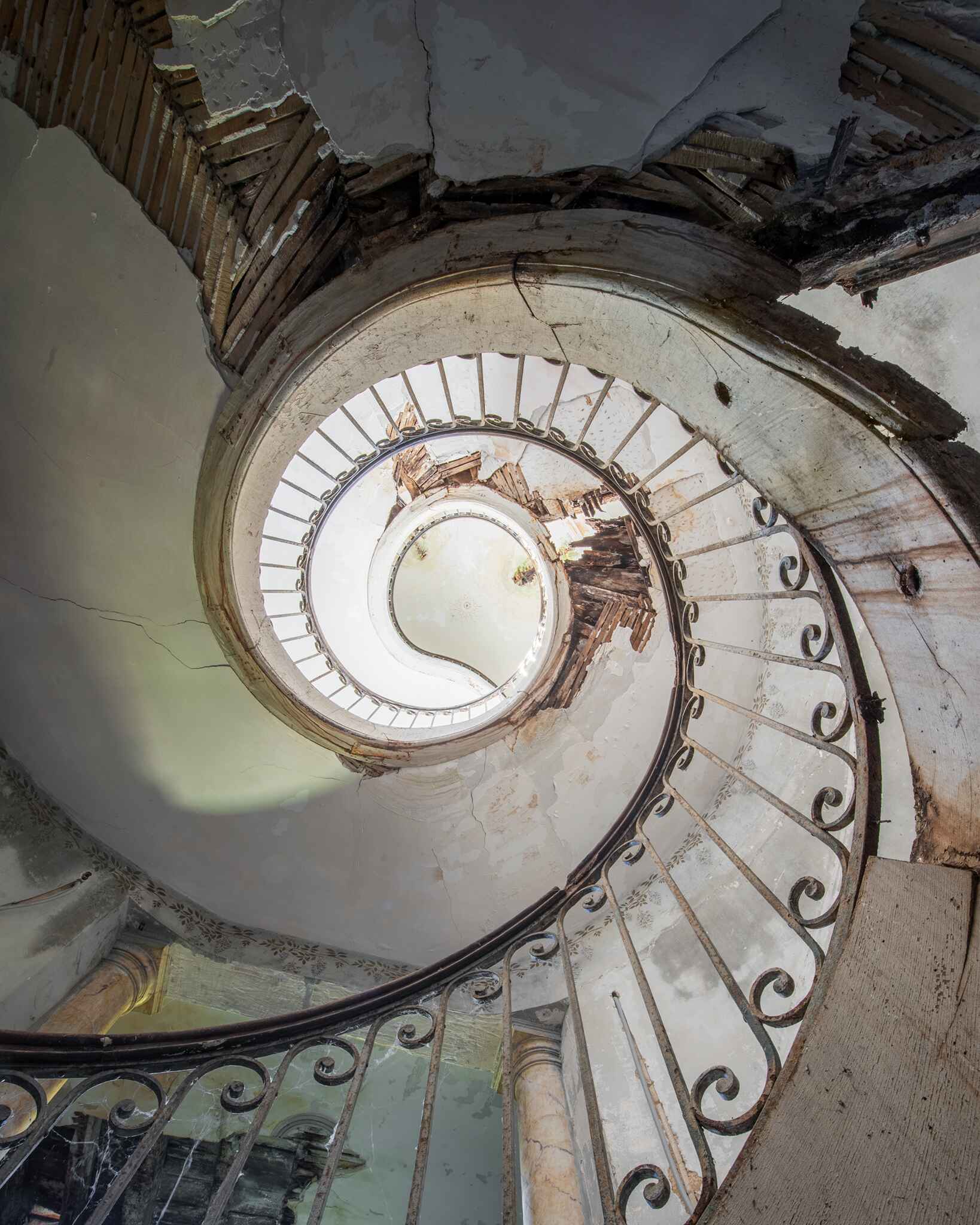
Today, there is a recognisable visual vocabulary of abandonment. The piano, the wheelchair, the peeling wall, the staircase, the tree growing through the floor. We recognise the genre immediately. And recognition can become a problem because one abandoned building begins to look like another.
For me, they are never interchangeable. I deliberately don’t reveal the locations of many of my photographs. Partly, it protects the places from vandalism and theft, but there is another reason: I don’t particularly want the viewer to think, “This is Villa X in country Y.” I’m not making a catalogue of destinations.
The location has to transcend its geography and become something else: a memory, a cinematic image, perhaps even a place that the viewer falsely believes they remember. Social media tells us where everything is. I’m still interested in hic sunt dracones: the places beyond the map.
M: Your recent work has increasingly taken you into industrial spaces. What do factories tell you about people that villas, theatres or churches cannot?
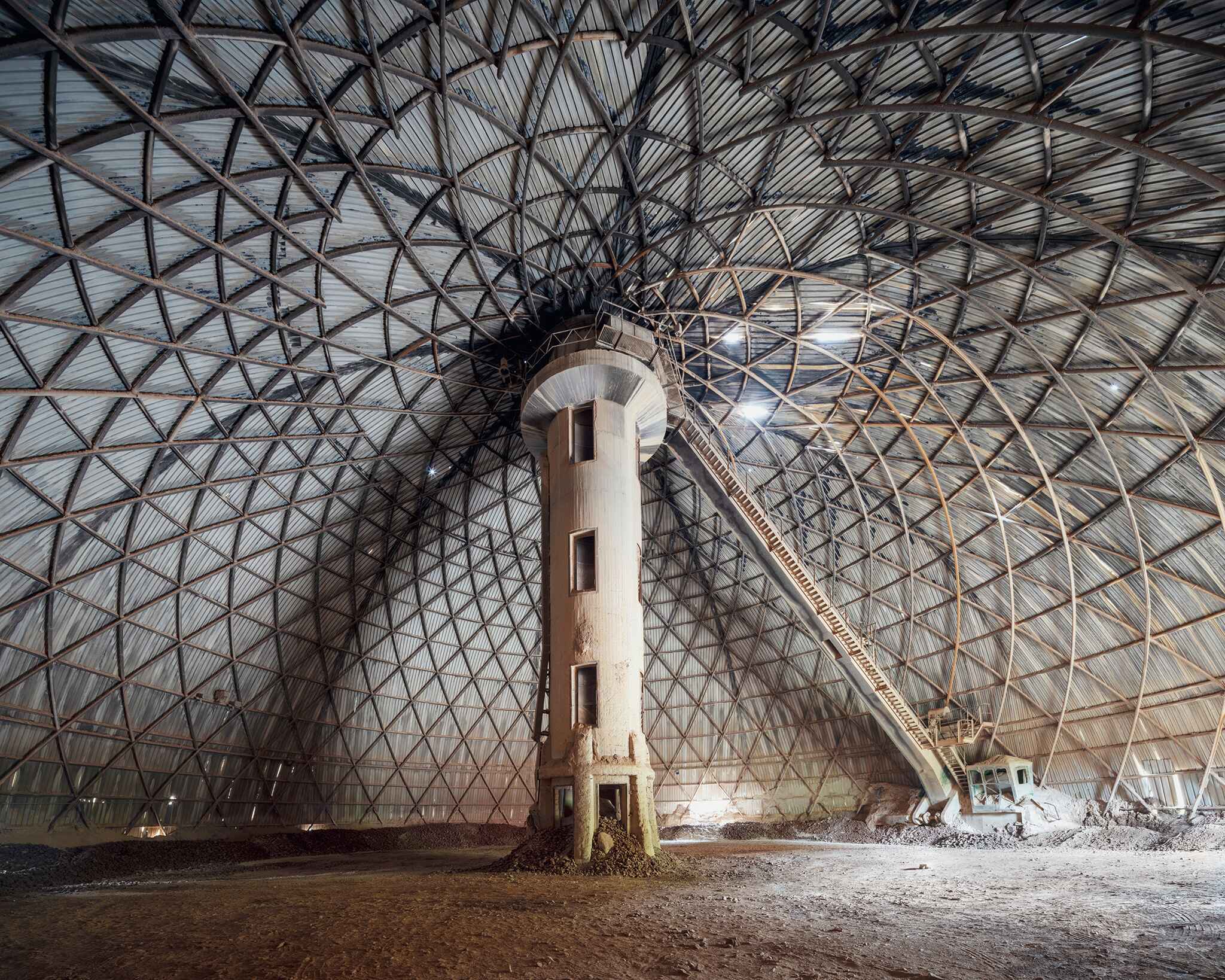
Factories change the scale of the human being. A villa tells you about an individual or a family: their taste, their wealth, their ambitions. A church speaks about transcendence. A theatre contains representation. A factory speaks about systems.
You stand beneath a cooling tower or beside a machine of absurd dimensions, and you feel two contradictory things: human beings are incredibly powerful because they constructed this, and incredibly small because they constructed a world in which thousands of people could spend their lives serving these machines.
When the factory stops, something extraordinary happens. Function disappears and form becomes visible. A cooling tower is a perfect example. From outside, it can be one of the most monotonous structures imaginable. Inside, it becomes almost metaphysical.
This is why industrial archaeology often activates science-fiction imagery for me. These machines belong simultaneously to the past and to some imaginary future. They become what I once called a catalogue of dystopian wonders. Ex Machinacomes from that fascination. Perhaps factories reveal Homo faber more nakedly than any villa can: the human being who invents, produces, transforms, and eventually abandons his own machines.
M: After photographing so many endings, what still has the power to surprise you?
Serendipity. Most of my work is obsessively researched, so I usually know where I’m going. Coordinates, maps, photographs, satellite images. There is a lot of preparation. But occasionally, on the way to somewhere I’ve researched for weeks, I see something completely unexpected. Those moments are wonderful because suddenly the adult researcher disappears and the eight-year-old comes back.
My fascination with these places probably began when I was a child, in a rather run-down amusement park near my home. I remember the rusting rides as something magical rather than ugly. Years later, when I accidentally encountered an abandoned amusement park, that sensation returned almost intact. Maybe that is what I’m still searching for. Not ruins, exactly. That moment when the world becomes mysterious again.
M: Is there a photograph in your archive that you understand differently today? What changed, the photograph or you?
Me, certainly. I’ve never really had a favourite photograph because I’m quite severe with my recent past. My judgement of my own work changes continuously.
Sometimes I look at an image I made ten or fifteen years ago, and I can immediately see what attracted me then: the spectacular staircase, the symmetry, the dramatic collapse, the cinematic light. Today, I may look at exactly the same photograph and notice a tiny object in the corner. That interests me because the photograph hasn’t moved by a millimetre. I have.
Maybe that’s also why photography and ruins belong together so naturally for me. We imagine the photograph as something that stops time, but its meaning doesn’t stop at all. The Italian writer Cristina Campo begins Passo d’addiowith this beautiful image of the hourglass being overturned, with the future already rising behind us. I used those words for the title of an exhibition because they contain something very close to what I feel about these places. We think we are looking at the past. But sometimes, looking at a ruin, we are looking at our future.