mrktr
  • Home
  • WORK
  • MAKERS
  • SCENES
  • SIGNALS
  • THE LADDER
No Result
View All Result
Marketer
  • Home
  • WORK
  • MAKERS
  • SCENES
  • SIGNALS
  • THE LADDER
No Result
View All Result
mrktr
No Result
View All Result
A former Boston Dynamics engineer hired Pixar animators to build a home robot

A former Boston Dynamics engineer hired Pixar animators to build a home robot

October 21, 2026
in News
Reading Time: 2 mins read
A A
Share to Facebook

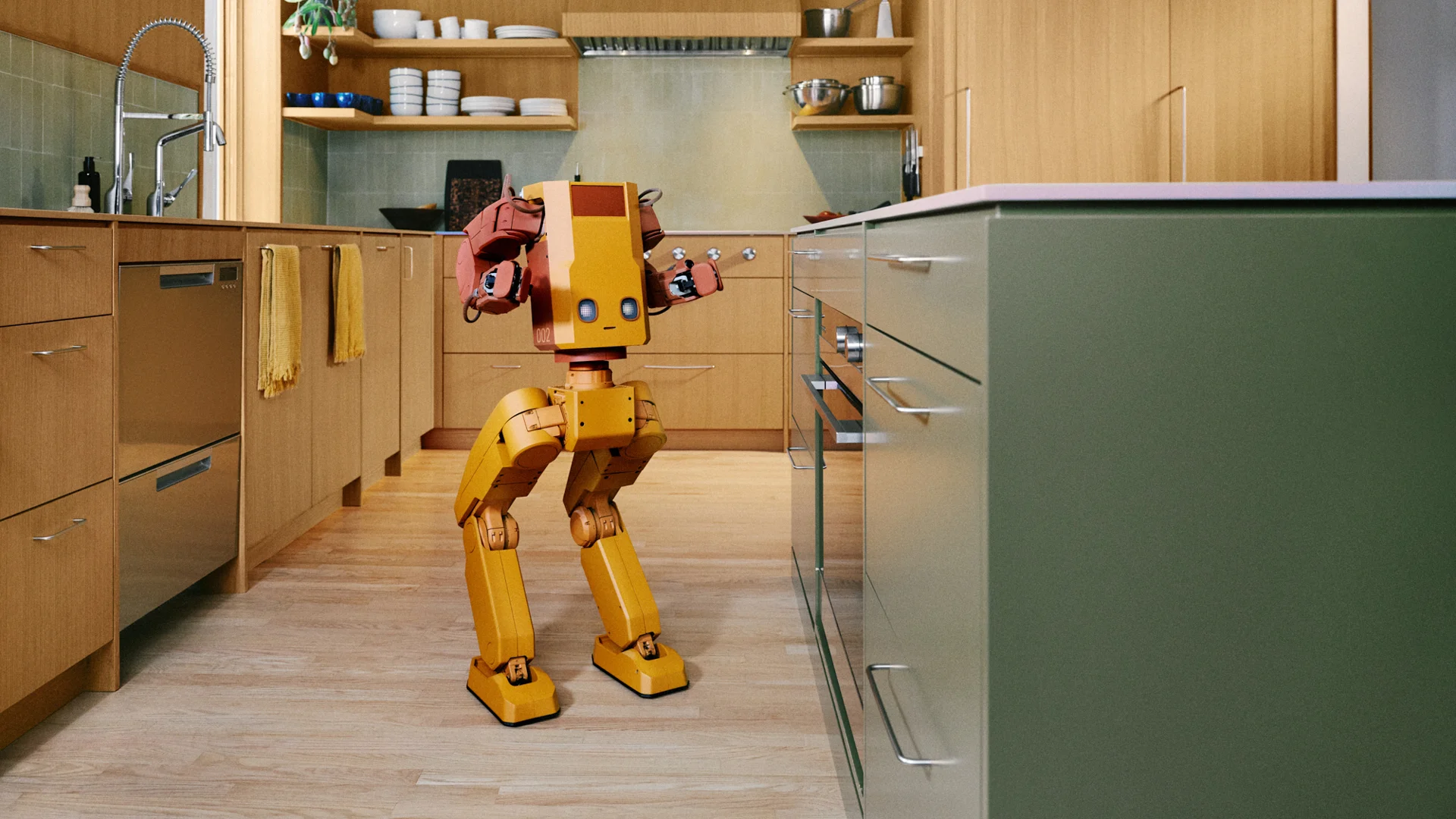
A New York startup thinks one of the hardest problems in home robotics is how a machine feels to live with. Tuesday Labs, founded by former Boston Dynamics engineer Rosalind Shinkle, has unveiled Voxel, a headless household robot whose movement was designed by Pixar animators before anyone taught it to walk.

A robot built around a character

Voxel has no head. Its 8-bit eyes sit on its belly, and it walks on pastel metal legs that bend backwards. Shinkle told Fast Company the design deliberately steers away from human resemblance, using the eyes and body language to carry emotion. The company has also written it a personality: obsessive, slightly anxious, and wary of water, the outdoors and sharp objects.

That character comes from people who have done this professionally. One Pixar animator built 3D animations of Voxel that are used to train its movement, and a Pixar veteran of more than a decade is developing its personality. The team animates a 3D model first, then trains the physical robot to reproduce that motion while coping with gravity, tilted floors and unexpected shoves. Its gait is tuned to match the animation, even where a more conventional walk would be more stable. “We’re really focused on building a robot that has a consistent character,” Shinkle said.

What it will actually do

The first job is what Tuesday calls a “home reset”: putting things back where they belong. Voxel will also fetch and find objects and handle repetitive chores such as watering plants, learning the layout of a home by continuously scanning it. Shinkle compares it to a Roomba with machine learning added. Laundry and dishes are the longer-term goal. Production is planned for 2028, at an estimated $20,000.

Why personality is a commercial bet

That price puts Voxel level with 1X’s Neo, a $20,000 humanoid due to reach US homes by the end of this year. According to heise, its first-year batch of 10,000 units sold out within five days. When rival machines cost the same and promise overlapping chores, buyers will judge them on more than a task list. A robot that lives in your kitchen is watched constantly, and the way it moves shapes whether it reads as a helper or an intruder.

Entertainment has already tested this idea. Disney Imagineering’s walking Olaf now roams Disneyland Paris, built with a similar animation-led approach to robot motion. Tuesday is betting that the same logic carries over from theme parks to living rooms.

The open questions

Tuesday is small. Y Combinator lists a seven-person team from its Winter 2024 batch, and the company has not disclosed funding. Two years is a long runway in a market where better-capitalised rivals are already taking orders, and charm will not make up for a robot that drops plates. If Voxel arrives on schedule, it will show whether consumers pay for a household robot’s personality as readily as for its capabilities, and the answer will influence how the next wave of home machines gets designed.


Tags: AIBoston Dynamicshome robotshumanoid robotsPixarrobotics startupsTuesday LabsVoxel
Share1Share6
Previous Post

Why Nike may have to let Converse go

Next Post

Singapore’s Paper Signs Reveal What Polished Design Misses

Related Stories

Fireflies Shouldn’t Become Something We Have to Explain to Our Children

Fireflies Shouldn’t Become Something We Have to Explain to Our Children

by Qetia
October 23, 2026
0

There is a particular kind of childhood memory that barely feels like an event. Standing outside after dinner. Waiting for the garden to grow dark. Seeing a small...

The Internet’s Security Problems Arrived All at Once

The Internet’s Security Problems Arrived All at Once

by Qetia
October 22, 2026
0

For a business, taking its own website offline is usually a last resort. On 21 October, it became an explicit recommendation from the US National Security Agency: organisations...

Zuckerberg told Meta he might leave California, where he could lose billion

Zuckerberg told Meta he might leave California, where he could lose billion

by Qetia
October 22, 2026
0

Mark Zuckerberg’s possible departure from California became a negotiation over who would control Meta as it financed its next phase of growth. Facing a potential multibillion-dollar wealth tax...

Silknet to Bring NVIDIA AI Infrastructure to Georgia

Silknet to Bring NVIDIA AI Infrastructure to Georgia

by Qetia
October 21, 2026
0

Silknet today announced that its wholly owned subsidiary, Silk Cloud, has signed an agreement to deploy NVIDIA Blackwell Ultra infrastructure in Georgia. The investment marks the first phase...

Next Post
Singapore’s Paper Signs Reveal What Polished Design Misses

Singapore’s Paper Signs Reveal What Polished Design Misses

mrktr

Independent media for the new generation of marketers, creators, and thinkers.
MRKTR | born in London, inspired by the world.

Follow us

Recent Posts

Zuckerberg told Meta he might leave California, where he could lose billion

Zuckerberg told Meta he might leave California, where he could lose billion

October 22, 2026
Apple Music Put Sound in a Bath of Oil and Turned It into a Brand Identity

Apple Music Put Sound in a Bath of Oil and Turned It into a Brand Identity

October 22, 2026

Weekly Newsletter

  • Home
  • Advertise
  • Marketer.ge
  • Privacy Policy

© 2026 mrktrg

No Result
View All Result
  • Home
  • WORK
  • MAKERS
  • SCENES
  • SIGNALS
  • THE LADDER

© 2026 mrktrg

This website uses cookies. By continuing to use this website you are giving consent to cookies being used. Visit our Privacy and Cookie Policy.