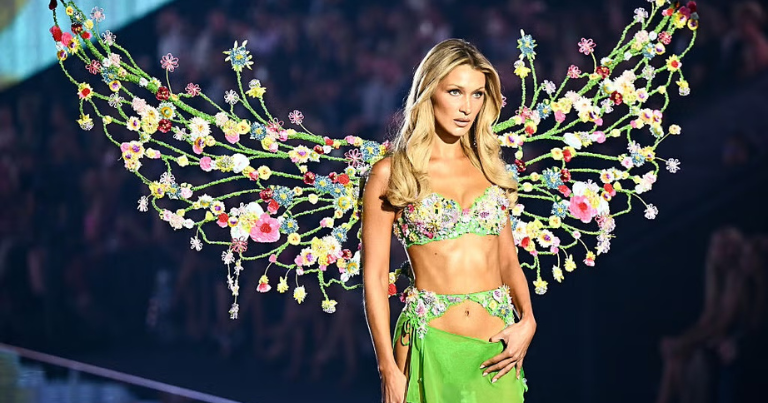
For years, the Victoria’s Secret Fashion Show made a few metres of runway feel like the centre of popular culture. The wings were enormous, the soundtrack familiar and the women wearing the lingerie presented as members of an unusually exclusive club. Viewers recognised their faces, anticipated their entrances and watched for the small moments that made a highly choreographed production feel personal. A smile towards the audience, a playful exchange with a performer, a particular way of turning at the end of the runway: these became part of a model’s public identity.
The show offered Victoria’s Secret something most retailers would struggle to buy through conventional advertising. It gave the company recurring characters. Models such as Tyra Banks, Heidi Klum and Gisele Bündchen helped make the brand recognisable far beyond its shops, while its televised spectacle introduced those personalities to audiences who might never have opened a fashion magazine. The annual broadcast became a powerful meeting point between fashion, entertainment and shopping.
Being associated with that world carried a particular kind of status. Victoria’s Secret could offer access to a vast audience, and appearing in the show suggested that a model had reached a coveted stage of her career. The brand benefited from her beauty, performance and personality; she benefited from the scale of its platform. Over time, the relationship could become so familiar that it was difficult to think of one without the other.
That arrangement still has value, but the balance has shifted. Today, a participant can arrive with a substantial audience, a business and a public persona already established. Her followers may know her daily routines, friendships and sense of humour before they have ever seen her on a professional runway. Victoria’s Secret enters an existing relationship between that person and her audience, bringing its own history and spectacle into a conversation already under way.
Kylie Jenner’s appearance in the 2026 show offered a particularly clear illustration. Making her Victoria’s Secret runway debut, the reality television star and beauty entrepreneur wore the returning Fantasy Bra, valued at $50 million. A tradition closely associated with the brand’s modelling history became the setting for a celebrity moment whose appeal reached across beauty, entertainment and social media. The choice brought a different kind of fame to an established ritual.
It is tempting to describe this as the moment influencers took over from supermodels. That version makes for an easy headline, although it compresses a much longer and more complicated transition. Victoria’s Secret still needs models who can command a runway, and its audience still has strong attachments to familiar faces. The more revealing change concerns the value attached to a participant’s life outside the show: the people who follow her, the conversations she generates and the attention she can bring with her.
The boundaries were already becoming less distinct in 2015, when Gigi Hadid and Kendall Jenner made their Victoria’s Secret Fashion Show debuts. Their arrival connected the event with a generation whose understanding of celebrity was being shaped by social feeds alongside magazines and television. Both could participate in the fashion industry while remaining visible to people who followed them for reasons extending well beyond their modelling work.
For audiences, that created a different route into the spectacle. Someone could watch because a person they already followed was about to walk, rather than discover that person through the broadcast. The anticipation began earlier, with announcements and preparations, and continued afterwards through photographs, reactions and commentary. A few seconds on the runway could sit inside a much longer personal narrative, one in which the brand had a prominent role without controlling every part of the story.
Meanwhile, the original television format was losing viewers. The US audience declined from 12 million in 2001 to 3.3 million in 2018, and Victoria’s Secret cancelled the annual show in 2019. Criticism of the narrow beauty ideal associated with the brand added pressure to a production whose relevance was already being questioned. A spectacle built around a tightly controlled fantasy faced an audience increasingly willing to challenge the terms of admission.
The difficulty was cultural as well as commercial. Exclusivity had helped make the show desirable, but it also invited scrutiny of who was consistently left outside the picture. Social media gave viewers somewhere to express that dissatisfaction publicly, compare the brand with competitors and circulate alternatives. Victoria’s Secret could still stage an event, but it could no longer assume that the most influential interpretation of it would be the one it had produced.
When the runway show returned in 2024, the cast demonstrated how much the brand still relied on professional modelling talent. Adriana Lima, Gigi Hadid, Anok Yai and Paloma Elsesser were among those who appeared. Their presence also showed why treating the shift as a wholesale replacement of models with influencers is misleading: the contemporary show brings together different careers, relationships with fashion and sources of recognition.
What has changed more decisively is the way those appearances reach people. A viewer can encounter an entrance on Instagram, watch a backstage exchange elsewhere and join a discussion about an outfit without ever sitting through the complete production. For that viewer, the show consists of the moments that reach their feed. Its running order matters less than the personalities and images that attract their attention.
This changes the commercial logic of casting. An experienced model may give a look authority and movement. A returning favourite may reconnect the brand with an audience’s memories. A personality with a devoted following may bring people who would otherwise have little interest in a lingerie show. One person can perform several of these roles, but a large follower count alone says little about how convincingly they will perform them.
Victoria’s Secret’s current presentation of the event reflects this extended relationship with its audience. Alongside the runway, its official show hub includes casting announcements, watch-party material, shopping and the Angels Among Usdocuseries. These give viewers reasons to engage before and after the main event, while creating more opportunities to connect entertainment with products. The show occupies a longer stretch of the marketing calendar than the performance itself.
There is an attractive efficiency to this approach. A single production can supply material for different audiences and platforms, while its participants provide additional routes for distribution. Yet it also creates a problem familiar to any brand working with a very famous person: the audience may be interested primarily in the person. Attention can gather around an appearance without attaching itself firmly to the company paying for the stage.
A widely shared clip therefore leaves several questions for the marketing team to answer through evidence. Viewers may recognise the celebrity while overlooking what she is wearing. They may discuss the casting without becoming more interested in the collection. Even enthusiastic reactions can be expressions of loyalty to an individual. The commercial task is to give that attention somewhere meaningful to go, whether towards a product, a stronger impression of the brand or a reason to return.
Victoria’s Secret also has to preserve the sense that its runway is worth reaching. Much of the old show’s appeal came from the professional achievement audiences associated with appearing in it. Casting for recognition can expand the audience, but if the event begins to feel like another interchangeable celebrity appearance, it risks weakening the prestige that made the invitation valuable. Popularity brings people to the spectacle; the quality of the spectacle has to justify their interest.
Broader representation should be understood on its own terms within this discussion. A change in the range of bodies, backgrounds or identities on the runway does not automatically amount to influencer casting. Models can have substantial professional careers alongside a strong social presence, and audiences can respond to someone for reasons that cannot be reduced to follower numbers. Conflating these developments makes it harder to assess what the brand is actually changing.
The most interesting part of Victoria’s Secret’s reinvention is this negotiation between its own fame and the fame of the people it invites in. The company has recognisable imagery, an archive of memorable performances and a format capable of attracting attention. Its participants bring their own histories and communities, some rooted in fashion and others spread across a much wider culture. The show works when those associations make each other more compelling.
For the viewer, it may still begin with a familiar face stepping onto the runway. For Victoria’s Secret, the outcome depends on what survives after that moment has been clipped, shared and replaced by something else in the feed. A celebrity can persuade millions of people to look. The brand has to give them something of its own to remember.